


Email marketing has long been a core part of the digital marketing toolkit, and it's now taking on a new dimension: artificial intelligence. Combining the two can improve the customer experience and give businesses a real edge, letting them run a personalized, data-driven email marketing process.
In this article, I'll walk you through the basics of email marketing, how AI integrates with it, and the points that matter most for businesses making that combination work.
Importance and Benefits of Email Marketing
Email marketing offers real advantages: it reaches a wide audience, supports personalization, and improves cost-effectiveness and conversion rates. That's why it remains a core part of digital marketing strategies.
Reaching a Wide Audience
Email lets you reach a large audience quickly and cheaply. A single campaign can reach a large number of people and prompt them to act.
Personalization
Personalization plays a big role in email marketing. Businesses can build customer loyalty by sending customized messages, product recommendations, and offers.
Collecting Feedback
Email marketing is also a channel for collecting feedback. Surveys sent by email can help identify customer satisfaction and needs.
Increase Conversion Rates
A well-planned email campaign can raise conversion rates. Content that addresses real customer needs, paired with engaging offers, is what moves people to act.
Cost
Email marketing costs less than most other marketing methods, especially traditional ones, so you can reach a wider audience without a bigger budget.
Traceability and Analysis
A range of tools let you track and analyze email marketing results. Metrics like open rates, click-through rates, and conversion rates show you what's working, so you can optimize future campaigns accordingly. For a closer look at the metrics worth tracking, check out our content!
Engagement
Email enables fast communication. You can get special offers and updates to your customers quickly and see a fast return on that outreach.
Brand Loyalty and Customer Communication
Finally, email marketing builds brand loyalty and customer engagement, keeping your brand top of mind for both customers and prospects and encouraging them to stay engaged.
Challenges and Competition
Like any marketing strategy, email marketing comes with its own challenges, and competition keeps growing. Brands compete for attention by offering more personalized, engaging content, while spam filters, KVKK (Personal Data Protection Law), and shifting customer expectations raise the bar further. All of this is what makes strong, effective email marketing increasingly important.
Spam Filters and Spam Emails
Spam filters stand between email marketers and their target audience's inbox, and users have also gotten quicker to block unwanted email.
Open Rates
Open rates are critical in email marketing, and reaching a strong one depends on engaging subject lines and content.
Targeting and Segmentation
Getting targeting and segmentation right matters a great deal in email marketing. Accurate targeting lets you deliver personalized content, while poor segmentation or targeting can undercut a campaign's effectiveness.
Data Privacy and Compliance
Data privacy matters almost everywhere, and email marketing is no exception. Complying with personal data protection laws, especially regulations like GDPR, is essential.
Mobile Compatibility
Last but not least, mobile compatibility is essential for making sure email campaigns reach customers the way they're meant to. Most people check email on their phones, and a mobile-unfriendly email can hurt the user experience.
Artificial Intelligence and Email Marketing
AI applied to email marketing helps optimize a range of things: analyzing customer behavior, delivering personalized content, finding the ideal send time, and targeting. That lets businesses build data-driven strategies into their campaigns, and the processes AI optimizes tend to increase customer engagement and improve conversion rates.
AI Supported E-mail Automation
AI-supported email automation simply means putting artificial intelligence to work in email marketing. With AI-powered automation, email marketing processes become more effective and more personalized.
Data Analytics
Data analysis is usually the first step in AI-powered email automation. AI can analyze large amounts of customer data, including past purchases, clicks, open rates, and website visits, to understand behavior and preferences. For example, it can pick up on a customer's interest in a particular product category, which then feeds into more effective email campaigns.
Google Cloud AutoML is a cloud-based system for analyzing data and making predictions, letting you build predictive models directly from your own data.
Personalization
Based on that analysis, AI can generate email content tailored to each customer: suggestions built around a customer's past purchases and interests, for example. That's what makes the resulting emails feel personalized and engaging rather than generic.
Dynamic Yield uses AI to deliver personalized content and recommendations, helping you build personalized emails and campaigns.
Determining the Ideal Posting Time
AI helps determine the best sending time for each customer based on their behavior. If a customer usually checks email in the afternoon, for example, AI will suggest sending to them then, so the message is more likely to get noticed.
Brevo (formerly Sendinblue) monitors and analyzes customer behavior, then uses that analysis to automatically determine send times that maximize engagement.
Segmentation and Targeting
AI analyzes customer data to build segments, creating targeted campaigns for, say, a specific geographic region or age range. That makes emails more targeted and more effective.
ActiveCampaign uses AI to segment your audience and automate customized emails for specific customer groups.
A/B Testing and Optimization
In email marketing, testing different variations helps you land on the most effective version. AI can generate those variations itself, send them to different customer groups, and analyze which one performs best, so you can keep improving campaigns and push conversion rates higher.
Optimizely is a platform for running AI-powered A/B tests on your email campaigns, then using the results to optimize toward the most effective version.
Brands' Email Marketing Successes with AI
Spotify
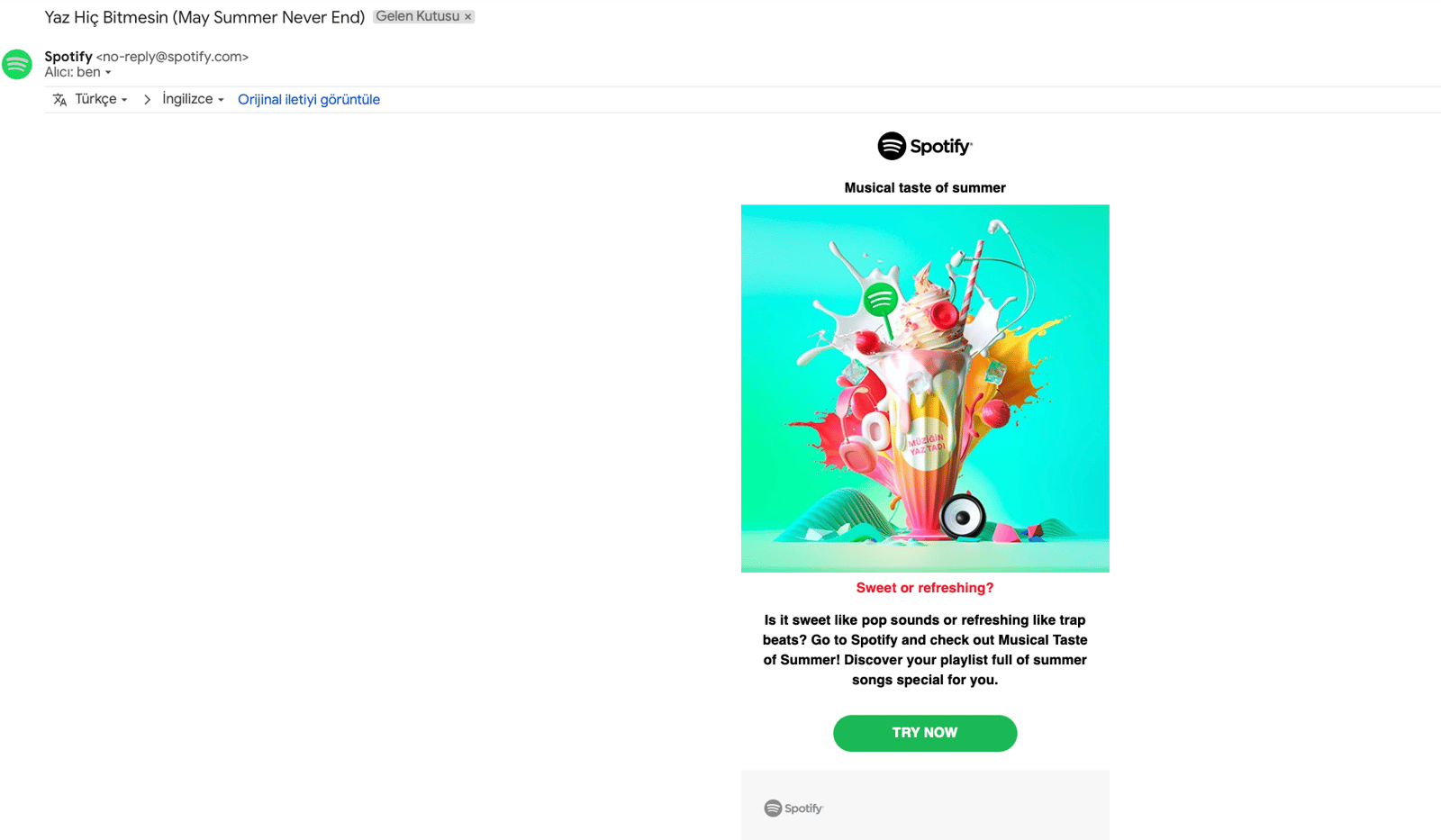
Spotify uses AI and machine learning to analyze listening habits and turn them into personalized music recommendations. Here's how that process works:
Data Collection: The platform gathers data on the songs, artists, and playlists users listen to.
Data Analytics: AI algorithms analyze that data to understand each user's preferences and habits.
Personalized Recommendations: Based on that analysis, AI generates personalized playlists and song recommendations for each user.
Email Marketing: Spotify sends users emails built around these personalized recommendations, with subject lines such as "Most Listened to Songs of the Week" or "Recommended Playlists for You".
Netflix
Using AI and machine learning, Netflix analyzes viewing habits and turns them into personalized movie and TV recommendations. Here's how that works:
Collecting Viewing Data: The platform gathers data on users' viewing history, ratings, and preferences.
Recommendation Algorithm: Machine learning algorithms use that data to recommend content based on each user's interests and preferences.
Personalized E-mail: Netflix sends users emails built around their viewing history and habits.

Both companies use AI and machine learning to understand user behavior and preferences, then turn that understanding into personalized email campaigns, driving more engagement and more use of their platforms.
The Future of Email Marketing with AI
As AI becomes a bigger part of the business world, email marketing's future will lean further into personalization and automation. Expect deeper analysis of customer data, more accurate predictions of user behavior, and campaigns built around that information, along with better optimization of send times, segmentation, targeting, and content recommendations. All of that gives businesses a real edge: more effective communication with customers and higher interaction rates.
AI-supported systems will help businesses analyze their email campaigns more closely and make improvements based on a clearer, data-driven read of performance.
Emerging Trends
Further Personalization: AI will keep refining recommendations to match each customer's specific needs and preferences.
Real-Time Interactions: AI that can read customer interactions as they happen will drive real-time email campaigns and recommendations.
Better Data Analytics: AI will help businesses understand customer behavior by analyzing big data faster and more effectively.
Expected Developments
Advanced Predictions: AI systems will predict customer behavior in more detail, for example, a customer's future buying tendency or price preference, making email campaigns even more personalized.
Voice Communication Integration: Voice assistants and speech-based interactions will start showing up in email marketing, opening new communication channels.
Data Privacy: As data privacy laws tighten, AI-powered email marketing will face more regulation, and privacy will only grow more important.
Potential Challenges
Data Security and Privacy: AI systems raise the stakes for customer data security and privacy, and businesses have to take on more responsibility because of it.
Lack of Technological Infrastructure and Expertise: Building the right infrastructure and finding specialized talent for AI-powered email marketing remains a challenge for many businesses.
Competition: As AI use in email marketing grows, competition keeps tightening, pushing businesses toward more creative, more effective strategies to stand out.
Last Words
AI and email marketing together are becoming a genuinely powerful way for businesses to reach customers, more personally and more effectively. Better analysis of customer behavior, more content personalization, and sharper targeting are all more accessible now than before, which raises the impact of email marketing and helps drive higher conversion rates and stronger customer loyalty.
In this article, we've covered the key points on using AI to strengthen your email marketing strategy and communicate more effectively with your customers. Follow our blog to keep up with new technologies and push your business further in a fast-changing AI landscape!
This content was created by Nursena Küçüksoy, Marketing Specialist at Zeo.


