


What are AI Overviews (AIO)?
AI Overviews (AIO) are AI-generated summaries that Google shows in search results to help users find information faster and improve their overall search experience. Google launched the underlying Search Generative Experience (SGE) to test users in the US in the second half of 2023, trying out different designs, studying how users responded, and working to correct inaccurate information. In May 2024, the feature was renamed AI Overviews and rolled out to general users in the US, followed by countries including the UK, India, and Japan. AI Overviews now appear in roughly 6.71% of searches.
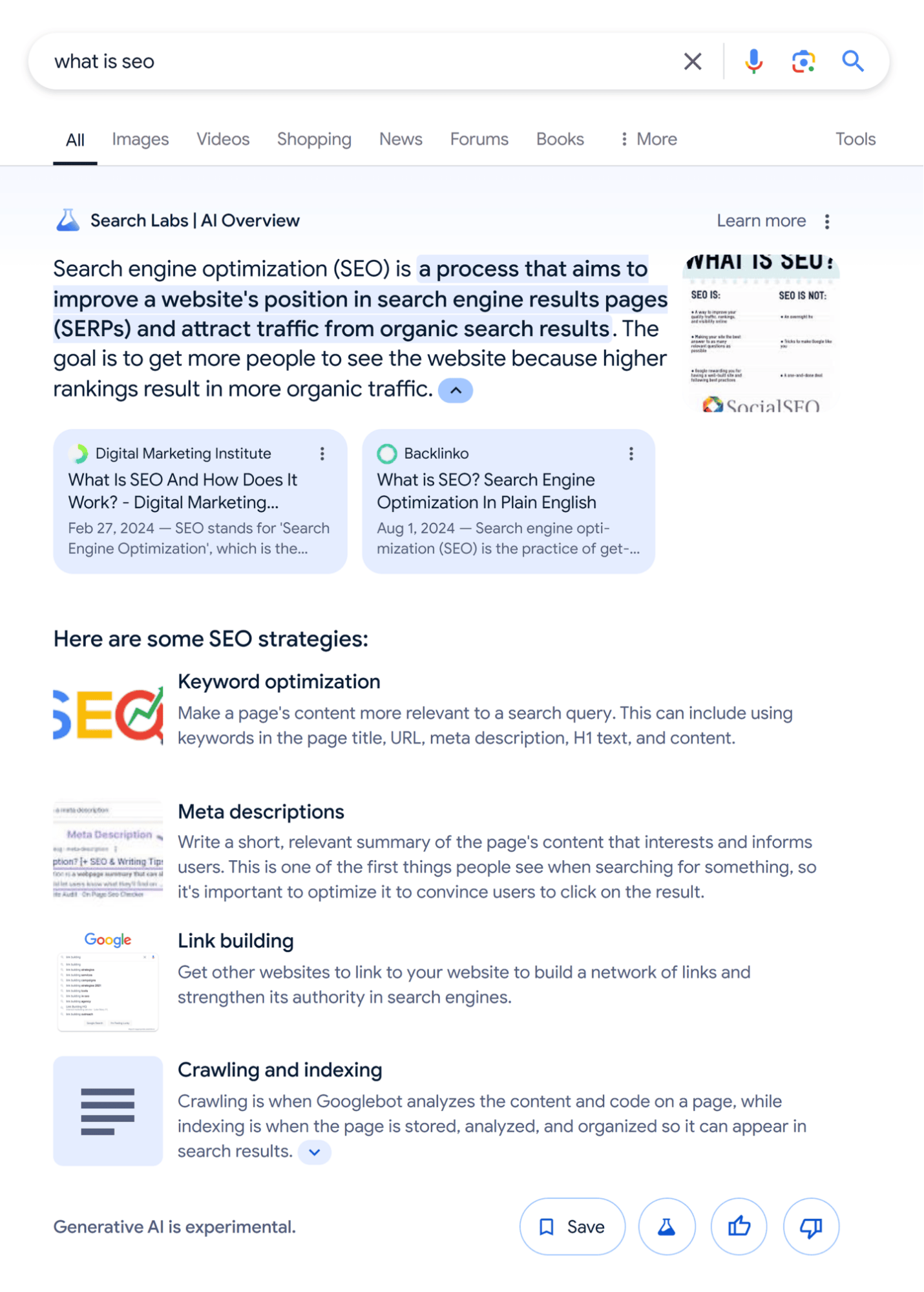
AIO pulls its information from websites and links back to the pages it draws from, so this section can still send organic traffic to the relevant pages. We know AI Overviews sit just below the ad results and above the organic ones, which means they're likely to affect organic rankings more than paid ones. AIO responses will also include ad links, marked with a “Sponsored” tag that can affect the click-through rate (CTR).
Being among the sources linked in AIO matters a lot, since it pushes organic results further down the page. According to Google, links inside AIO actually receive more clicks than the same page would in a normal organic ranking.
One of the biggest benefits for users is the interactive areas within AIO, which make it easier to ask follow-up questions, dig into the details of a topic, and compare options.
AI Overviews modules
Beyond the text responses we see most often in AIO, Google also uses visual and list-based modules to improve the user experience. The most common modules so far are:
– Text Modules: Summary information, detailed explanations, graphs, links, related questions
– List Modules: Step-by-step guides, annotated lists, bulleted lists
– Table Modules: Information, price, service comparison tables, scheduling tables
– Product Modules: Product viewers with product images, prices and key features, product carousels, reviews and price comparisons
– Interaction Modules: “Modify” and ‘Add’ buttons to modify or add suggestions, user-expandable sections for additional information
Tired of reading?
You can also listen to this blog post as a podcast we created with Google NotebookLM on Spotify.
Sectoral Statistics
Health, science, and internet are the sectors where AI Overviews show up most often, while entertainment, food and beverage, and real estate see them the least.
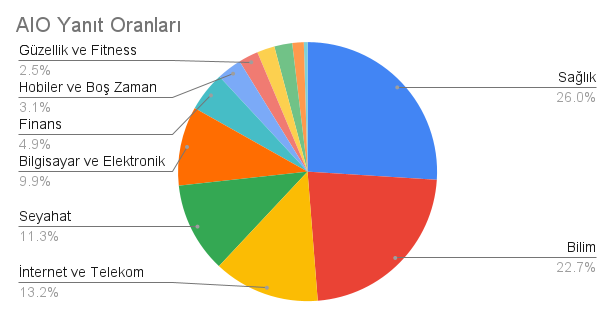
AIO responses appear in 23% of e-commerce queries, a high enough rate to make them a real priority for e-commerce sites. In this sector, AIO responses often include useful details like product carousels, price comparisons, and reviews, which can improve the shopping experience for anyone searching for a product. Financial queries are a different story: since the accuracy of investment-related information is so sensitive, AIO responses show up in only 5% of financial searches.
AI Overviews Answers to Seen Queries
Here are the query types where AI Overviews shows up most often on Google's search results pages:
Knowledge queries: questions where someone wants to learn about a topic
Example: How are the northern lights formed?
Question queries: the classic what, why, how, and when patterns
Example: Why do plants like the sun?
Planning queries: queries built around planning something
Example: The best towns for a summer vacation in Italy
E-commerce queries: product searches or comparisons
Example: TV stand suitable for 65 screen TV
Education queries: career and education questions
Example: Professions that industrial engineers can do
Health queries: questions in the health space
Example: Causes of neck pain
Pros and Cons for SEO
AI Overviews has been one of the most exciting SEO developments of 2024. We know organic traffic depends heavily on the click-through rate of each ranking position, so adding a new element above the organic rankings on the results page is bound to change those click-through rates too.
Pages used as sources for AIO answers are expected to see click-through rates similar to the position 1 spot, and possibly even higher, since users who spot familiar, trustworthy information in the AIO answer may be more inclined to click through. On the other hand, because AIO already answers much of the user's question, many of these searches may not send traffic to any site at all. That's a real visibility risk for smaller websites in particular, which makes investing in content strategy and technical SEO even more important for them.
The table below breaks down the positive and negative effects of AI Overviews on SEO.
| Pros | Cons | |
|---|---|---|
| User Experience | It provides fast and detailed information, reducing the need for users to conduct a second search. This builds trust in the originating site. | Users who get their answers in AI Overviews do not need to click on sites (Zero-click search) |
| Organic Traffic | It can attract more qualified traffic to the content used as a source and increase brand visibility. | It can lead to a decrease in organic traffic, especially for sites that remain at the bottom of the rankings. |
| Sectoral Differences | Greater visibility in knowledge-driven sectors such as healthcare, education, and e-commerce. | YMYL requires high standards across categories, which can be a challenge for small-scale content producers. |
| Optimization Opportunities | The chances of ranking can be increased by investing in content quality; long-tail keywords offer the opportunity to reach a wider audience. | It requires investment in technical details such as visuals, structured data, and schema markup. |
| Source Selection | AI Overviews prioritizes trusted sources, giving more chances to authoritative sites. | Credibility issues may arise if images and content are based on faulty sources. |
The Future of AI Overviews
Wider Fields of Use
AI Overviews is currently live in a handful of countries, with more expected to follow soon. It hasn't launched in Turkey yet, but that's exactly why it's worth preparing for now. We see AI Overviews show up most often in sectors like health, education, and e-commerce, which makes it a priority for websites in those spaces, and it's likely to spread to other sectors before long. Whatever sector you're in, if organic traffic matters to your business, it's time to start optimizing for AI Overviews.
Ad Integration
We're already seeing Google add ads into AIO responses, and more ad modules are likely on the way. That's bound to affect the user experience: when an AIO answer draws on data from advertiser sites, some users may start questioning how reliable that answer really is.
Reliable Information
Gemini, the language model behind AIO responses, will keep evolving and should become more accurate over time. The SGE trials produced some inaccurate answers early on, which drew criticism and cost some user trust. As Gemini improves, we expect it to get more precise about which sources it selects, likely leaning more heavily on authoritative websites. That means the authority of your own website is going to matter even more.
User Experience
As AI Overviews becomes more common, the whole Google search experience will shift, and interactive questions will be a big part of that change. We can expect AI Overviews to lean more heavily on this kind of question-and-answer format going forward, along with more of the modules users engage with most, like images, lists, and tables.
Evolution in SEO
To make up for the organic traffic that AI Overviews responses “steal” from organic results, websites need to invest much more in content strategy and SEO. It's not enough to just produce content that ranks well organically; you also need to optimize specifically to be among the sources AI Overviews links to. For e-commerce sites, structured data will play an even more critical role in that effort.


