


Hello everyone, in this article we'll look at how artificial intelligence is being used in the retail sector, and how it will shape our lives before long.
From yesterday to today, plenty of innovations have transformed and developed technology worldwide. Cell phones, computers, and the internet are among the innovations we probably use hundreds of times a day, making our lives easier in the process. If these deeply rooted innovations disappeared overnight, we'd fall into a real void, and artificial intelligence has reached exactly that kind of position in today's technological age.
According to Statista, the international value of artificial intelligence reached 428 billion dollars in 2022, 515 billion dollars in 2023, and 620 billion dollars in 2024. This figure is expected to exceed 735 billion dollars in 2025, and it's projected to reach 2 trillion dollars by 2030.
Artificial intelligence, constantly developing at pace, first entered our lives through more limited communication methods, especially in written communication form. It developed quickly and started making our lives easier visually and auditorily too, visualizing what we have in mind within seconds through a few prompts. Given that we're still using a very limited slice of what AI can do even in its current form, it's fair to say the technological developments ahead of us will reach very different dimensions before long.
We now turn to AI for most of what we used to ask search engines, using it to plan an affordable travel route, decide what to wear to our best friend's engagement party, or pick a birthday gift for our brother. With AI, we can reach information that used to take several search-engine queries with a single prompt. That saves us time and also lets us filter our search for more efficient results. For example, when I type into a search engine what to wear to my best friend's engagement party, I see blog content from different brands and paid, sponsored brand names come up.

_Source, Google_When I send a similar query to ChatGPT, I get dresses in many different colors and styles, along with links to sites where I can buy them. Where search engines would need me to review 5-10 different blog posts and sites to build that same list of dresses, I can get completely different dress suggestions from 5 different brands just by typing a simple prompt like "My best friend is getting engaged in April, what can I wear?" Then, by continuing to describe the color and style I like, I can find and buy the dress that suits me best in as little as 10 minutes.

_Source, ChatGPT_As another example, let's say I'm buying a birthday present for my brother. Sending the same prompt I typed into a search engine to AI instead, I get paid ads from sites like Temu and Swarovski, along with Trendyol's blog post on the topic.

_Source, Google_Thinkbuddy gives me a list of sites and content for gift ideas too, but sending the same query to Thinkbuddy gets me a much more detailed list. From there, filtering by my budget and my brother's interests narrows things down to a much smaller set of options, and I can order the gift quickly through the site links it gives me.

_Source, Thinkbuddy_Beyond how we use AI individually in daily life, sectoral AI use has grown considerably over the past 2-3 years too. It shows up across plenty of sectors in different ways, from booking reservations to customer service, from personalized product or content recommendations based on past user behavior to early disease diagnosis through medical image analysis. In the rest of this article, we'll look more closely at AI use in retail, with real-life examples.
Using Artificial Intelligence in Real Time
Retail is one of the leading sectors when it comes to adopting AI-driven innovation. Looking at the developments and innovations of the last 5 years alone, what's coming over the next 5 looks even more exciting. So what are these innovations? Cashless stores, fast-troubleshooting chatbots, voice assistants, AI-supported demand forecasting, and robot-supported operations... Let's look at real-life examples in more detail:
1. Personalized Shopping Experience
Artificial intelligence has opened the door to consumer-oriented behavior and personalized shopping experiences. We can now virtually try on a product we're considering, and get recommendations tailored to our skin type and body shape within seconds. Plenty of brands have moved quickly to adopt AI-driven technology in their businesses to build customer loyalty. According to research by McKinsey, personalization can cut customer acquisition costs by up to 50%, lift revenue by 5% to 15% and marketing ROI by up to 30%, and improve customer outcomes overall.
Let's walk through a few examples of brands offering personalized recommendations through AI:
- Amazon's AI-powered personalization system lets it drive more sales by compiling recommendations quickly, based on a user's previous purchases, reviews, and search history. With Amazon Personalize, it builds smart user segments to prioritize each customer's individual needs. By analyzing past purchases or search history, the algorithm offers suggestions across everything from the most suitable sizes for a customer to style suggestions, while also accounting for the fact that sizes may change over time. For example, say you bought clothes for your 1-year-old niece. When you search for an outfit for your nephew again later, Amazon's AI-supported algorithm factors in that your nephew has grown since then and adjusts its clothing suggestions accordingly.
- The Nike By You platform collects data from app users, color preferences, favorite activities, shoe sizes, to build highly personalized experiences for customers. On this platform, you can design and buy your dream shoe in as little as 15 minutes. Nike uses the data it collects through the app to decide which sneakers to stock in which stores, and to shape where the company heads next.

_Source, Nike By You_- Bershka's 'Custom Lab' and H&M's 'Creator Studio' let customers create personalized products to their own taste. These tools strengthen the bond with customers and encourage on-demand production, letting brands lean into their sustainability goals. On these platforms, you first pick the product you want to customize, then quickly purchase your design after choosing things like color and pattern. As an example, I ran a test in Bershka's Custom Lab, starting to design a T-shirt using 'Reflective,' one of the design ideas the platform offered. From there, you can continue with Ford or Hello Kitty-themed options, or just add your own text.

_Source, Bershka_From there, I moved to the purchasing stage by picking the color, pattern, and placement of the pattern from the menu that opened up. In as little as 10 minutes, I created and bought a product I'd designed myself.

_Source, Bershka_- Marks & Spencer uses artificial intelligence as a style consultant to boost online sales. Through an AI-built testing system that draws on information like a customer's body shape and style preferences, M&S offers personalized product recommendations based on that data. Aiming to make online shopping more appealing, the brand saw a 41% profit increase and a 9.4% sales increase last year through this application.
Tired of reading?
You can also listen to this blog post as a podcast we created with Google NotebookLM on Spotify.
2. Virtual Trial and Augmented Reality Experiences
- Virtual trial has added a whole new dimension to the customer experience and has been adopted by plenty of brands, making online shopping easier along the way. A study by Shopify found that virtual interaction with products leads to a 94% higher conversion rate.
- Another study found that 61% of consumers are more likely to shop with a brand using advanced technology, while more than half (55%) say they're more likely to engage with products from brands offering personalized recommendations tailored to their needs.
- Nike brings a whole new dimension to virtual shoe-fitting technology. Noting that 60% of individuals wear ill-fitting shoes, and hundreds of thousands buy the wrong size every year, Nike scans customers' feet with a smartphone camera and offers exact shoe size recommendations to prevent that problem. Through this technology, the brand aims to cut return rates and lift customer satisfaction.
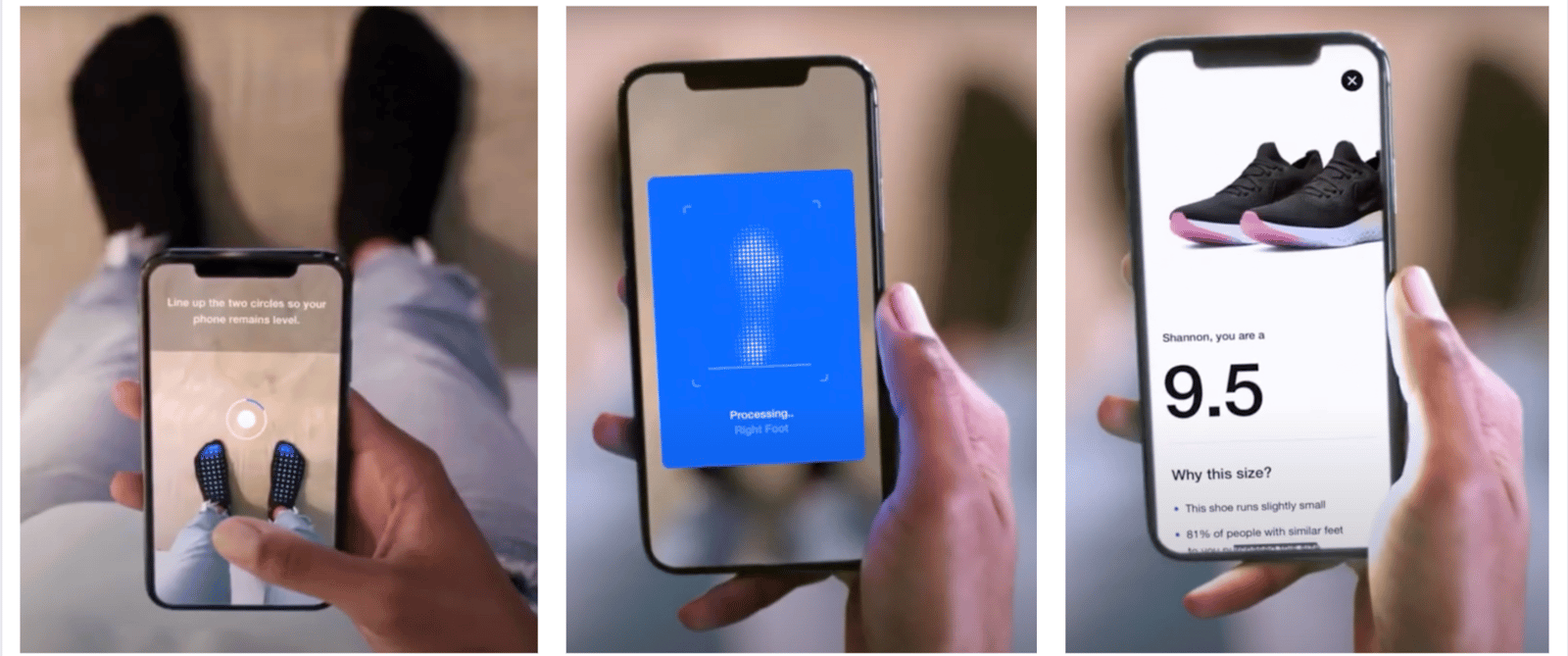
_Source, urdesign_- Amazon uses a virtual try-on feature for shoes too. It doesn't offer much on sizing, but it does let customers see color and model choices in practice.
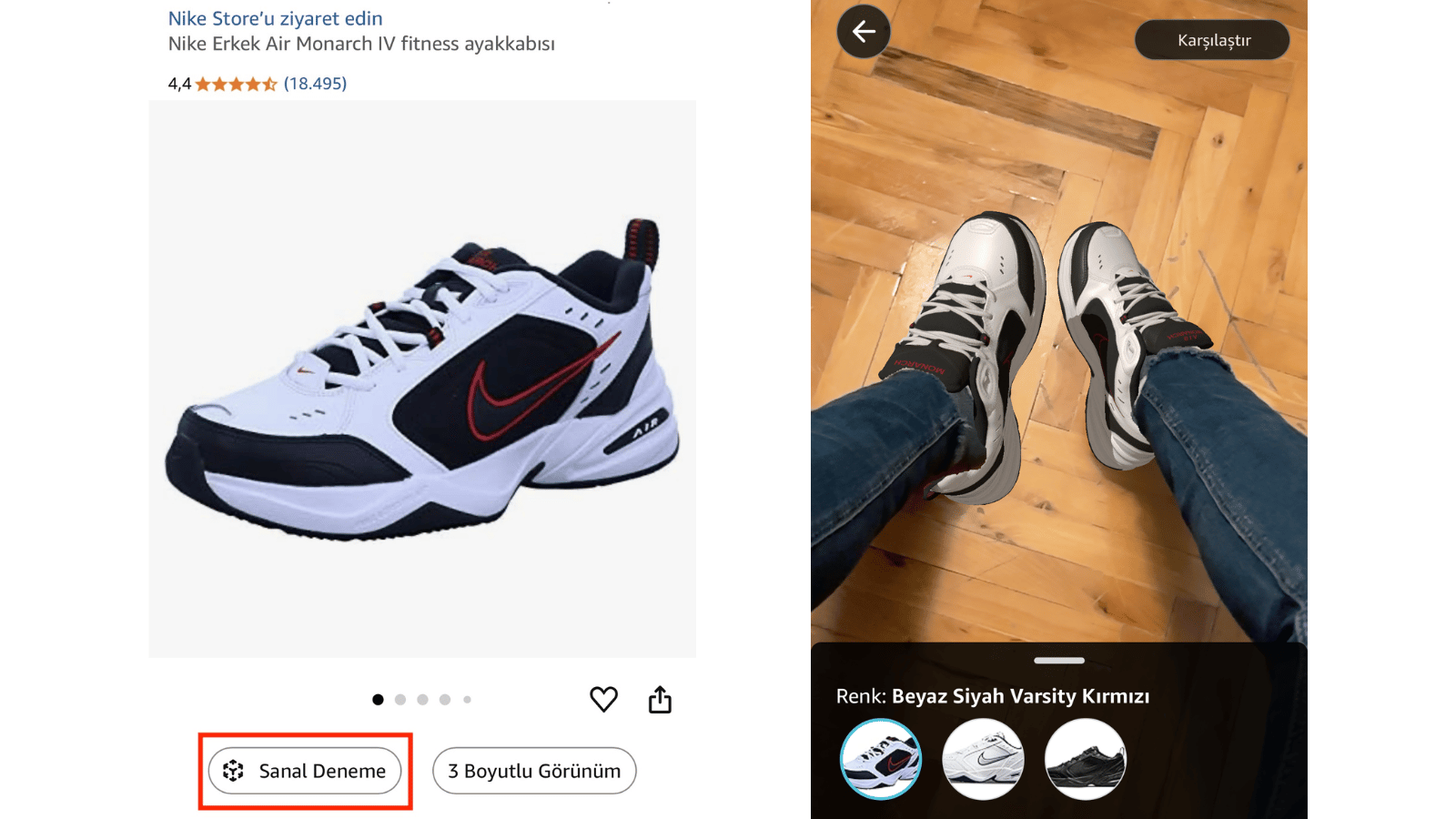
_Source, Amazon_- Similarly, with Flo's "see it on your feet" application, you can try on the shoes you're considering buying, using your phone's rear camera.
- With a similar application, Atasun Optik lets you see which of dozens of sunglasses styles best suits your face shape.
- IKEA lets people see how the furniture they're planning to buy will look in their home or office before they buy it. IKEA Place lets people pick the color and size of furniture based on how well it fits the room.

_Source, IKEA_- Beauty brands such as Flormar, Loreal Paris, and Sephora let you virtually try on the makeup products you're curious about, either on your own face in real time or on a model of your choice. That way, users can test lipstick or foundation shades on their face and find what matches their skin tone, even while shopping online.
3. Product Reviews and Evaluation
- Hepsiburada uses AI to objectively summarize the comments customers leave on products they've purchased. These responses, built on ChatGPT, help other users get an objective read on the product before buying, offering a better shopping experience overall. For example, looking at a Yataş product, we can see comments from 1053 purchasers summarized into a single paragraph by AI. With this feature, potential customers can get a feel for a product without reading through thousands of existing reviews.

_Source, Hepsiburada_Hepsiburada also uses a ChatGPT integration to encourage users to leave comments. Based on the words previous purchasers frequently use in their comments, it suggests keywords for new purchasers to use in their own reviews, which people can then edit and publish in their own voice once they've shared their experience with the product.
4. Cashless and Smart Stores
Cashless stores and smart cabinets are another innovation making the shopping journey easier in retail. A few brands leading this shift:
- Amazon pioneered the cashless, cashierless grocery store model. Called Amazon Go, the store lets customers log in through a smartphone app, and sensors on the shelves automatically track the products they select. When customers finish shopping and leave the store, the products get billed to their credit card, cutting out the traditional checkout wait entirely.

_Source, Midjourney_- Walmart uses FoxBot forklifts, AI-powered autonomous robots, across its distribution centers. FoxBot works efficiently and carefully, from figuring out pallet locations to handling sensitive loads, cutting the risk of product damage tied to manual forklift work. This lets Walmart increase operational efficiency while making it easier to collect and analyze data through autonomous technology.
5. Chatbots and Voice Assistants
- H&M's AI-powered chatbot offers quick fixes for problems that come up shopping online or in physical stores. Testing it out, I asked about the return process, and it told me exactly how many days I had to return purchases, and under what conditions.
****_Source, H&M_- Another example is Zara's AI Virtual Assistant, which resolves questions about orders, returns, account management, gift cards, and more, without needing to reach customer service at all.
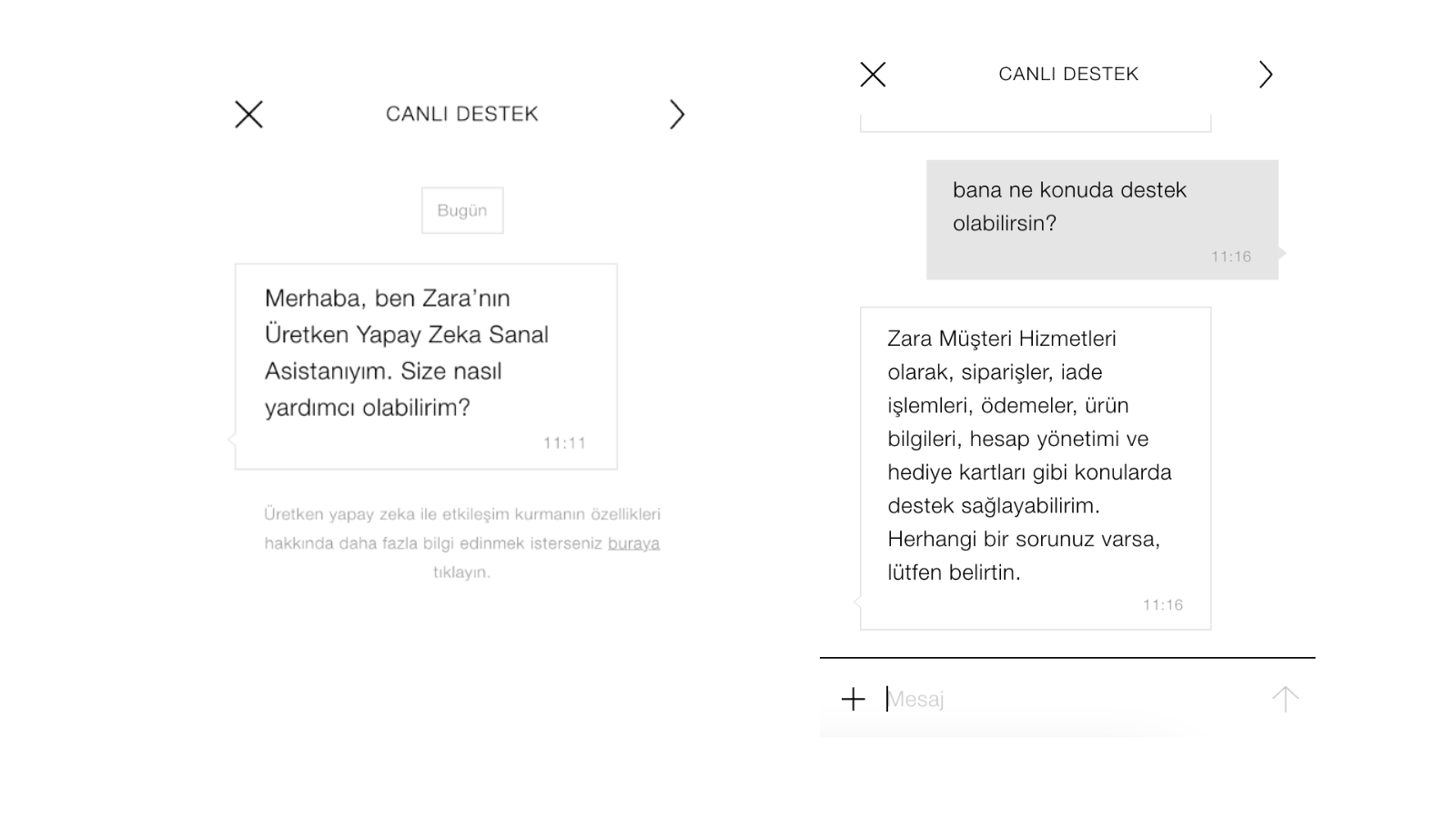
_Source, Zara_6. Supply Chain and Logistics Innovations
- Zara has successfully woven AI into nearly all of its processes, extending across its entire supply chain and inventory management. Key elements of its strategy include the Just-In-telligent supply chain system, RFID tagging, real-time analytics, and machine learning.
With these technologies, Zara can spot high-demand products quickly and start developing new product strategies around them, while identifying low-selling products just as fast and pulling them from sale. That lets the brand adapt to rapidly shifting market trends with relatively little effort. Through this use of AI, Zara cuts inventory costs and shortens delivery times, while also improving delivery accuracy.
- Looking to improve how it sources and stocks products to better meet customer needs, Nike acquired the AI startup Celect to strengthen its predictive analytics. Celect draws on retail data to help companies organize inventory and run cost-benefit analysis. The acquisition lines up with Nike's push to grow direct-to-consumer sales across channels like its mobile app and website.
Bonus:
With Kolors Virtual Try-On, a free clothing try-on application, you can see any clothing item on any person you choose within seconds. To do this, start by visiting the website and add a clear photo of the person you want to see the outfit on to the first box.

In step 2, add a clear image of the outfit. As an example, I'm trying a black dress I like on Jennifer Aniston:
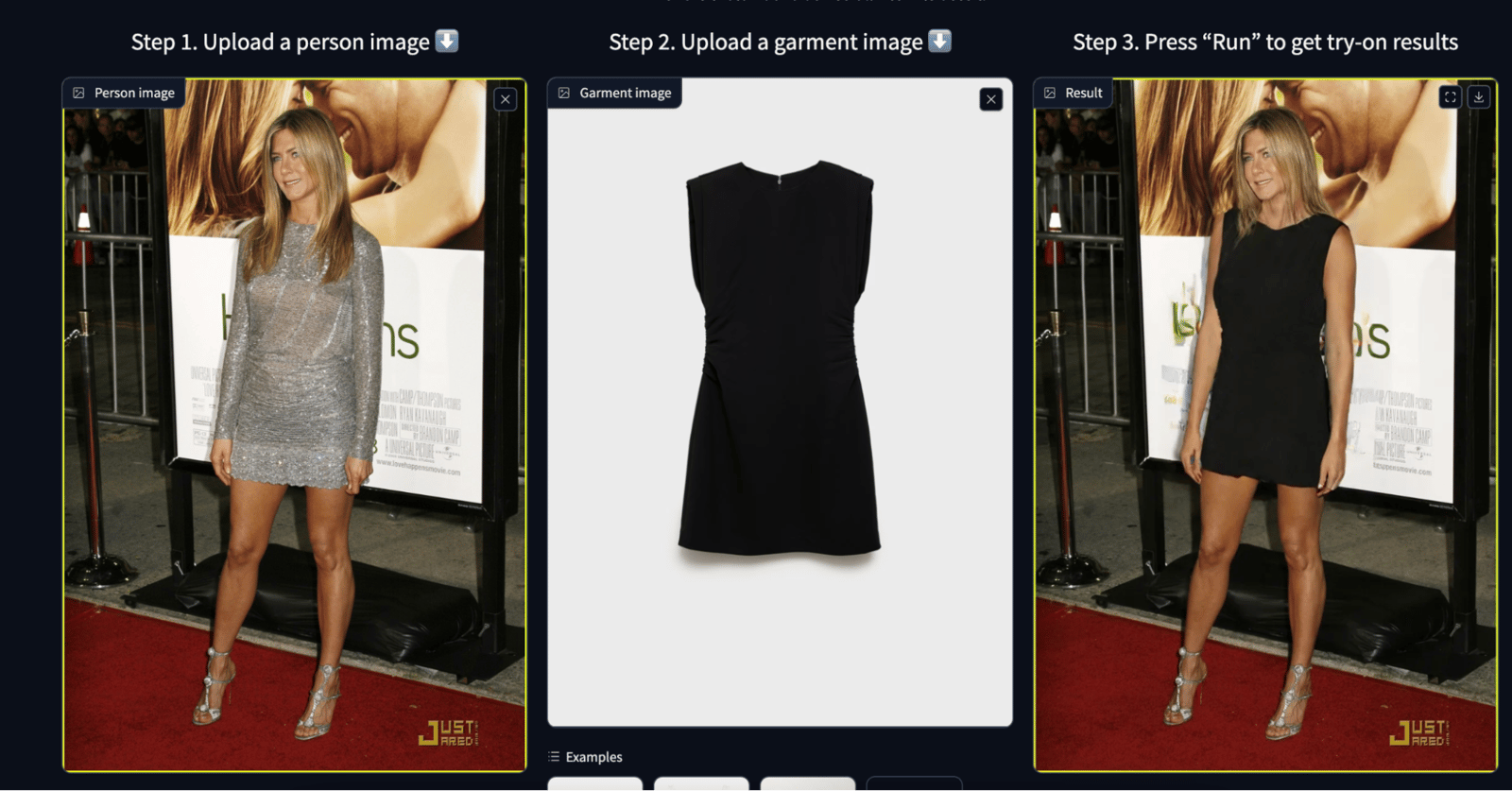
As you can see, I got the result I wanted very efficiently, within about 1 minute. You can try on clothes you're curious about with this application, and skip the long stretch spent in a fitting room.
In this article, we set out to show you real examples of AI use cases in retail. I hope you found it worthwhile. For more AI-related content, visit our AI Blog page. If you're not sure how to bring AI into your business and want somewhere to start, you can contact our teams here. See you in new articles!


