


SearchGPT, the next-generation AI-powered search engine developed by OpenAI, is drawing more interest every day. If you want your website to show up in SearchGPT, you probably have questions: what it is, how it works, and what it takes to rank. In this article, we'll go through what SearchGPT is, how it works, its key features, how it differs from Google, its ranking factors, and the strategies that help you become more visible in it.
What is SearchGPT and Why is it Important?
SearchGPT is a search engine powered by OpenAI's artificial intelligence technology. Its biggest difference from traditional search engines is that instead of just listing results, it pulls together the information from those results and gives you a direct answer, which makes for a noticeably better experience. It also understands what you're searching for more accurately, thanks to AI and natural language processing, so the results tend to be more relevant.
The biggest benefit of being a “generative” model is that SearchGPT doesn't just find the information you searched for; it creates an original answer synthesized from different sources based on exactly what you asked.
Let's compare the Google and SearchGPT experience with an example:

In SearchGPT, I searched using a more conversational question, specifying the date and type of event I wanted. The answer gave me exactly what I needed. It had the right dates and only listed concerts. Getting a brief summary of each one meant I didn't have to click through page after page.
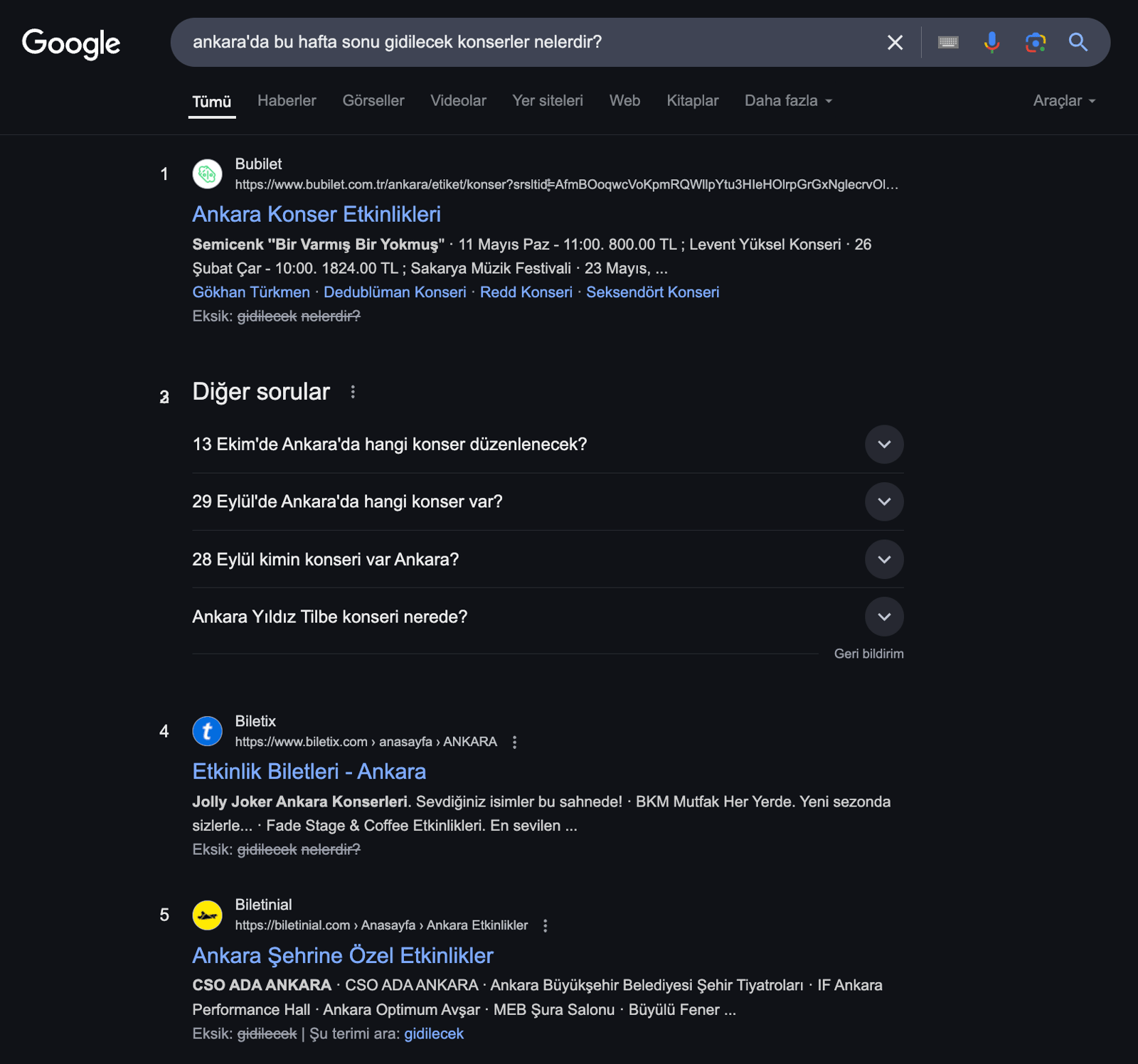
This search may be “too” long tail for Google. It couldn't handle the phrase “this weekend” and returned results without any date filtering. The top listings show concerts in Ankara, but the results below mix in all events in Ankara, not just concerts. Overall, this is a poor experience.
Looking at how SearchGPT actually works explains why it performs better in examples like this. Instead of matching keywords alone, SearchGPT analyzes the context and purpose behind the sentence. It uses natural language processing and machine learning to figure out not just what you're looking for, but also what you want to know and what you want to do. One of its biggest features is real-time access to web data: it pulls from the index of the Microsoft Bing search engine using a technique called RAG (Retrieval Augmented Generation).
RAG works in two phases. First, it retrieves web pages relevant to the request from the Bing index, the “retrieval” phase. Then it uses that page's content along with ChatGPT's own knowledge to create a meaningful response, the “generation” step. Finally, this response is presented along with the resources it drew from.
Tired of reading?
You can also listen to this blog post as a podcast we created with Google NotebookLM on Spotify.
Key Features of SearchGPT
Let's look at SearchGPT's key features in more detail.
- Speech-based interface: SearchGPT lets you ask questions and search for information in natural language. After your first question, you can keep expanding the search by asking more questions, just like a conversation. It remembers previous questions and answers, so nothing gets taken out of context.
- Direct responses: Traditional search engines list multiple pages as the answer and leave you to read through them and find the answer yourself. SearchGPT presents the answer directly, in formats such as summaries, definitions, lists, and tables, so you save time and reach what you're looking for faster. Combining and summarizing information from different sources is also useful for understanding complex topics.
- Quotes panel: SearchGPT is transparent about where its information comes from. That increases credibility and, since it's grounded in real-world data, reduces the likelihood of hallucinations. If you want more detailed information on a subject, you can easily access the original content. Since SearchGPT analyzes multiple sources, it can also present different perspectives.
- Real-time information: SearchGPT pulls live data directly from the internet to generate its answers. This matters for constantly changing information such as trending topics, weather, and financial news.
- Data does not change the algorithm: According to OpenAI, SearchGPT doesn't use this information to train its algorithm. It does this to respect the intellectual property rights of content creators and to keep its algorithm from being biased by those ideas.
SearchGPT Ranking Factors and Ranking Tips
To be among the pages used as a source in SearchGPT, it helps to understand how those pages are selected. Looking at the ranking factors, most of them turn out to be things you'd already consider on an SEO-compatible web page. Let me list these factors first, then explain what you need to do in detail.
- Content Relevance and Contextual Understanding
- Semantic understanding and alignment with user intent
- Natural language use and tone of voice
- Long-tail keywords
- Depth and breadth of knowledge:
- Comprehensive content, subheadings, and FAQs
- Authoritative information and expert opinions
- User Interaction Signals:
- Clear and simple language
- Readiness for conversational flow and follow-up questions
- Content Freshness:
- Up-to-date information and regular updates
- Republishing
- Structured Data and Accessibility:
- Structured headings (H1, H2, H3)
- Bullet points and numbered lists
- Readable language and appeal to a wide audience
- Authority and Credibility:
- Quotes and sources
- Domain authority
- Backlinks
- Brand awareness
- Speech Based Search Features:
- Optimization for follow-up questions
- Adapt to user personas
- Voice search optimization
- Technical SEO:
- Mobile optimization
- Meta descriptions
- Site speed, website performance, and Core Web Vitals
- Organized page structure
How to Rank in SearchGPT?
- **Focus on User Intent: **
- Focus on why your audience is searching, not just what they're searching for. What problem are they trying to solve? What information do they need? What questions are they asking?
- Put yourself in your target audience's shoes and try to see things from their perspective.
- Do research! Keyword analysis, competitor analysis, reviewing forums in your industry, and social media will help you.
- Create Conversation-Based Content:
- Use natural language, write as if you were talking to a friend.
- Create content in a question-and-answer format.
- Explain complex topics with examples and in detail.
- Deliver In-Depth Content:
- Cover all aspects of the topic, and go into detail instead of staying superficial.
- Show that you're an expert in your field through your experience, research, and expert opinions.
- Divide the topic into subheadings so readers can easily find the sections they're interested in.
- Touch on other topics related to your main topic. This makes your content more comprehensive and valuable.
- Long and detailed content tends to perform better in SearchGPT (avoid verbiage just for the sake of length; quality and comprehensive information matter more).
- Structure Your Content:
- Segment your content logically with headings and subheadings. This helps search engines and users understand your content better.
- Present information in lists to increase readability and make it easier for SearchGPT to summarize your content.
- Visualizing your data with tables and graphs makes your content more interesting and understandable.
- Short paragraphs are easier to read and understand than long blocks of text.
- Use Examples and Applications:
- Illustrate your point with real-life scenarios.
- Success stories help your reader take action with more confidence.
- Explain how to do it step by step, and turn it into a guide.
- Provide practical information, tips, and tricks.
- Keep Your Content Up-to-Date:
- Review and update your content regularly. Add new information and remove what's outdated.
- Update the publishing date of your content whenever you refresh it.
- Follow developments and trends in the industry and update your content accordingly.
- Provide Reliable Information:
- Support your information with references. Cite and link to your sources.
- Make sure the information you provide is accurate.
- Be as objective as possible and include different opinions.
- Appeal to a Wide Audience:
- Avoid technical terms, or when you use them, define them so everyone understands.
- Your content should be easy to read for readers at every level of knowledge.
- Use a combination of text, video, and images to appeal to different learning styles.
- Create Engaging Content:
- Use attention-grabbing and intriguing headlines.
- Write an introduction that attracts the reader's attention and previews the information they're about to read.
- Pay attention to storytelling. Stories grab people's attention and make it easier for them to retain information.
- Encourage your readers to comment, interact, and share.
- Optimize Technical SEO:
- Make sure your website loads fast. You can optimize images and use caching and a CDN for this.
- Make sure your pages display properly on mobile devices.
- Use a descriptive URL structure, use keywords, and keep it as short as possible.
- You can help your website get crawled more easily by using a sitemap.
- Use schema markup to give search engines more information about your data.
- Increase Brand Awareness:
- Links from other websites are a signal of credibility for search engines. Try to earn backlinks from quality, relevant websites in your industry. You can do this through content marketing and outreach.
- Make sure your brand is mentioned when getting backlinks.
- Be active on social media and share your content.
- Bing Optimization
- Add your website to Bing Webmaster Tools and track your performance on Bing.
- Submit your sitemap to Bing.
- Use Bing Keyword Research to analyze what your target audience searches for on Bing.
- Make sure your content is optimized according to Bing's guidelines. It's generally similar to Google, but there are some differences.
- Register your business on Bing Places for Business.
SearchGPT is a harbinger of change in the search engine world and has the potential to revolutionize the user experience. This change represents a new opportunity for website owners and content creators. As we've discussed in this blog, to get traffic from SearchGPT, you need to go beyond traditional SEO techniques and optimize your content around a strong user experience. You can become visible in SearchGPT with a website that has strong technical SEO and a solid brand reputation, along with comprehensive, reliable, and up-to-date content.
SearchGPT is still a new topic at the time of writing this blog, and it's possible that ranking factors will evolve or the experience will improve in the future. It's not hard to predict that artificial intelligence will play an increasing role in search engines. Don't forget to follow Zeo Blog and Zeo's social media accounts to keep up with the developments!


