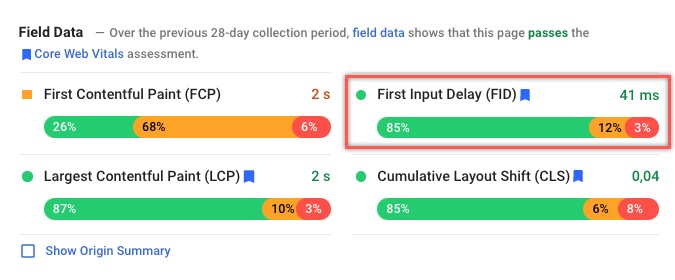
First Input Delay, or FID, measured the time between a visitor's first interaction with a page, a click, a tap, a keypress, and the moment the browser was actually free to start responding to it. A high FID meant the browser was too busy running other JavaScript to react right away, which reads to the visitor as a page that looks loaded but doesn't respond.
FID was one of Google's original three Core Web Vitals, but Google replaced it in March 2024 with Interaction to Next Paint (INP) as the responsiveness metric that actually counts toward Core Web Vitals scoring. The core problem FID measured hasn't gone away, unresponsive pages are still a real issue, but INP measures it more completely: rather than only capturing the delay before the first interaction, INP tracks responsiveness across every interaction throughout the whole visit, which gives a fuller picture of whether a page stays responsive or just starts out that way. FID still shows up in some legacy tooling and historical reports, but INP is now the metric that matters for current Core Web Vitals evaluation.