


In 2022, OpenAI's launch of ChatGPT kicked off a rapid acceleration in how much AI touches our lives, and today that impact has spread into nearly every field. Countless AI products now exist, each finding its own way to reach its intended audience. The companies behind these AI tools rely on AI engineers to shape their products to the right standard and deliver a seamless experience to their users. In this piece, we'll cover AI engineers and AI engineering in full detail, since they play such an active role in the tools we use every day. Let's start by understanding what AI engineering is for and what it actually does.
What is Artificial Intelligence Engineering?
AI engineering is a field of engineering that tries to give machines the ability to think, perceive, and solve problems the way humans do. It gives things like computer systems and robots capabilities that would normally require human intelligence, including:
- Speech and natural language processing
- Image and voice recognition
- Machine learning
- Problem solving
- Decision making

To bring these abilities to computer systems or robots, AI engineers develop complex algorithms and models, integrate software and hardware components, and train machines on large amounts of data. Voice assistants on phones, for example, run on a voice recognition system that AI engineers built using exactly this kind of engineering.
What Does an Artificial Intelligence Engineer Do?
The main goal of AI engineers is to make machines and computer programs intelligent, teaching them to think and make decisions the way humans do. AI engineers aim to produce outputs that imitate human intelligence across multiple dimensions, effectively building computer programs that can think and decide like a person would. Within that framework, they teach computers to speak, understand images, and solve problems, all in pursuit of the right output.
Take a robot built to help around the house, for example. An AI engineer can teach it to wash dishes, iron clothes, and sweep the floor, letting it handle housework intelligently. Or take the voice assistant on your phone: an AI engineer can program it to speak and understand you, so it can answer when you ask it something.
Here's another example. Say you buy a robot dog and tell it to 'sit', but it just barks instead, because no one has taught it to sit yet. This is where an AI engineer comes in, programming the robot dog to detect the sit command through cameras and sensors and to act on it.
Or take an example from mobile technology: phone cameras keep getting better every year, and many now include a night mode that lets you take pictures in the dark. How does a phone camera actually detect that it's night? That's AI at work. AI engineers give the phone camera special programming that can enhance night photos, training it on millions of day and night photo examples. So when the phone recognizes it's shooting in a dark environment, it switches into night mode and brightens the photo as though it had been taken in daylight. In a sense, your phone can think, even if it can't quite see, and automatically improve the shot.

In short, AI engineers make our daily lives easier by writing code, working with data, and building these kinds of programs. Put simply, AI engineering is the work of teaching machines to think like humans.
A Closer Look at the Work of Artificial Intelligence Engineers?
We've already introduced what AI engineers do above. Now let's dig into the details with a few concrete examples.
Algorithms
AI engineers develop algorithms. In a maze game, for instance, they might teach the program to find its way through the maze using an algorithm.
Data Collection
Data is the single most important thing for an AI engineer. If they're working on voice recognition, for example, they'll collect recordings of different people speaking and feed that dataset to the program.
Training Machines
Machines learn from data. We can, for instance, teach driverless cars to follow the road and stop using cameras and sensors, which lets the car drive itself without a human behind the wheel. In fact, driverless taxis in the United States recently got stuck on the road after an internet outage.
Testing
For example, engineers have a chatbot talk with real people and evaluate how it responds, then refine the product based on that evaluation.
Software Development
A translation program, for example, might start out supporting just one language. Through further software development, engineers write the code that lets it translate between multiple languages. This is where AI engineers play an active role in the software development process.
In short, AI engineers play an active role throughout the development and application of AI.
Artificial Intelligence Methods
AI covers many different methods. These methods build on terms like machine learning and deep learning, and the concept of AI is the common thread running through all of them. Using the right AI method lets AI engineers find the most effective solution by working with the appropriate model.
What is Machine Learning? Where is it used?
Machine learning lets computers or robots build the right model based on patterns and inferences. Computer systems use machine learning to process and identify large datasets. The amount of data available is the most decisive factor in how well the learning turns out, since more data helps the model predict results more accurately. Say we want to teach a robot to tell an apple apart from an orange. We'd show it pictures of apples and oranges as a dataset, and by studying those images, the robot would learn what makes an apple an apple and an orange an orange, eventually reaching the correct result on its own.
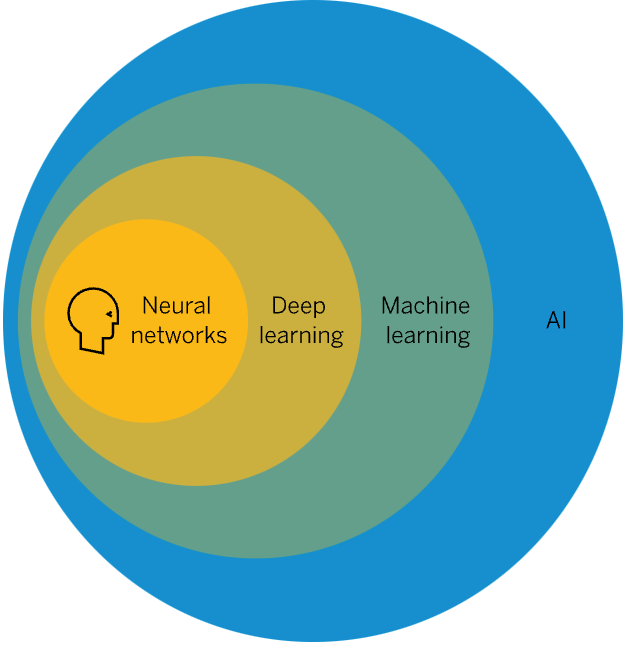
Machine learning shows up across many industries in our lives, including manufacturing, banking, financial services, entertainment, and retail. In banking, for instance, it can help detect credit card fraud or suspicious transactions. In gaming, think of the games you play against the computer: the computer improves with each of your moves and adjusts its own moves as it learns.
What is Deep Learning? Deep Learning with Examples
Deep learning is a machine learning technique modeled loosely on the logic of the human brain. It achieves high-capacity learning by using intelligent systems like artificial neural networks. Deep neural networks are made up of layers that receive inputs, process them, and produce outputs. Each layer takes the previous layer's output, processes it, and passes it on to the next. This deepens the learning process and lets us reach human-level output on complex problems.
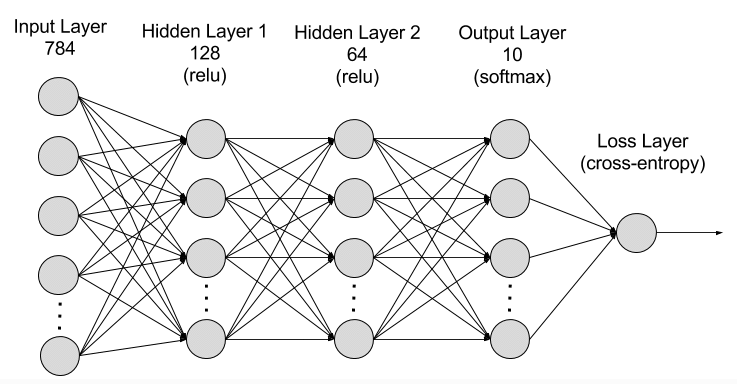
Take a deep learning model built to detect fraud or suspicious transactions in a mobile banking app. The input layer receives the customer's transaction data, things like amount, date, and location. Several hidden layers then check whether the transaction fits the customer's past habits, such as their typical amount limit, location, or day of the week. The next layers check for other fraud signals, like IP address or device used. The final layer decides whether the transaction looks fraudulent or suspicious based on all these features combined. As you can see, the many hidden layers between input and output deepen the model and let it learn complex patterns, which is exactly how the bank catches fraudulent transactions.
Here's another example. Take a deep learning model that recommends content based on your interests on a social media app. The input layer receives the user's sharing and comment history. The following layers extract the user's interests from that data. Deeper layers narrow in on more specific interests by analyzing the accounts the user follows, the posts they like, and the videos they watch. The final layer suggests posts the user is likely to enjoy based on all these inferences. That's how the app ends up recommending personalized content through its deep learning model. You can also find a comprehensive Zeo Blog guide to Generative AI here.
What is Natural Language Processing? What are Natural Language Processing Applications?
People don't talk in perfectly formed sentences. Natural language processing (NLP) lets computers understand human language by generating and presenting the right output in response. Take a sentence like "Can you get my son's shoes at home?" A computer would struggle to make sense of that. NLP is what lets us teach computers to parse speech and writing like this. In other words, even though a computer doesn't know grammar the way a human does, NLP lets it understand us anyway. That's how computers can now answer our questions, chat with us, and translate text. Voice assistants, translation programs, chatbots, text summarization tools, and spell checkers are all major NLP applications. The autocorrect that fixes your typos while texting on your phone, for instance, runs on natural language processing behind the scenes.
Master the Right AI Tools for the Right Job!
AI covers branches like deep learning, machine learning, and natural language processing, so it's worth remembering just how broad the field is and how many different methods it includes.
Say we're designing a robot to clean the house: we could teach it cleaning motions through machine learning, letting it carry out different cleaning tasks. Or if we're building an AI to chat with a friend, we'd reach for natural language processing so it can understand and respond to conversation. Or if we're developing a tool to help doctors diagnose patients, we could use deep learning to analyze images.
As these examples show, it makes more sense to match the AI method to the purpose and train your tools with that method in mind. Picking the right method matters enormously if you want to build a successful, high-impact AI product.
Being an Artificial Intelligence Engineer
AI engineers have knowledge and skills across all the areas above, but they apply them across many domains to bring intelligence to computer programs and machines.
Skills Required to Become an Artificial Intelligence Engineer
Becoming an AI engineer takes creativity, patience, and a knack for teamwork. Loving the process of finding new ideas and solving hard problems matters a lot here. Since the field moves fast, keeping up with new technology means constantly developing your own skills.
AI engineers need to learn programming languages like Python, R, and Java, which let them apply AI models, especially machine learning and deep learning algorithms, effectively.
Beyond technical skills, human skills matter too. Building up communication, problem-solving, time management, teamwork, and critical thinking all make you a stronger candidate for the field.
Given that AI is set to be everywhere in the future, working in this space will become an exciting and important career path. A university degree in computer engineering or software engineering will give you a strong entry point into the field as a student.
Sources:
- https://aws.amazon.com/tr/what-is/machine-learning/
- https://www.sap.com/turkey/products/artificial-intelligence/what-is-machine-learning.html
- https://www.indeed.com/career-advice/finding-a-job/ai-engineer
- https://www.simplilearn.com/tutorials/artificial-intelligence-tutorial/how-to-become-an-ai-engineer
- https://professionalprograms.mit.edu/blog/technology/artificial-intelligence-engineering/
- https://www.ibm.com/topics/natural-language-processing
- https://www.tableau.com/learn/articles/natural-language-processing-examples
- https://aws.amazon.com/tr/what-is/deep-learning/


