


Marketing is built on understanding how consumers behave and guiding them along their path to purchase. Behavioral economics offers an invaluable set of insights for that journey, and Prospect Theory in particular is a powerful tool for understanding how people perceive risk and weigh gains against losses. Applying this theory can sharpen your marketing strategies and help you build deeper connections with your customers.
What is Prospect Theory?
Prospect theory explains how people make decisions under risk. The way people evaluate gains and losses is shaped by a reference point rather than absolute utility, and that reference point is usually the current situation or a set of expectations. The theory matters for marketing because of what follows:
The Power of Loss: Under Prospect Theory, gains and losses aren't evaluated the same way. People feel more pain from a loss than they feel pleasure from an equivalent gain, an asymmetry known as the "power of loss." The value function is concave for gains (diminishing marginal utility) and convex for losses (increasing marginal loss). In practice, that means smaller gains carry more relative value than larger ones, while smaller losses hurt less than larger ones.
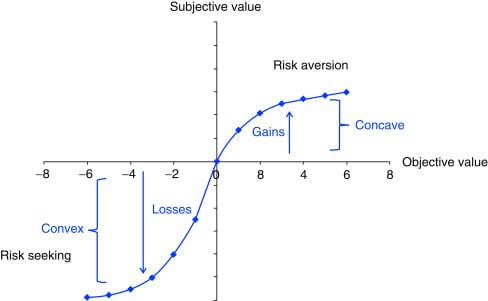
This chart illustrates the basic principle of Prospect Theory: Losses have a stronger effect than gains. The value function is concave for gains and convex for losses. This means that small gains are more valuable than large gains, but small losses are less painful than large losses. For gains and losses at the same level, the loss is more painful.
The Importance of the Reference Point: Under Prospect Theory, people judge their decisions against a reference point rather than absolute values. That reference point could be someone's current situation, their expectations, past experience, or a point of comparison. For example, earning 100 TL might feel like a bigger gain to someone earning 500 TL than it does to someone earning 10,000 TL. In your marketing messages, you need to account for your customers' reference point and shape your messaging around it.
Risk Perception: People don't always assess probabilities at their true value. Especially with low probabilities (winning the lottery, say) and high probabilities (like contracting an illness), people tend to exaggerate them, while assessing mid-range probabilities more realistically. That creates both opportunities and pitfalls for marketers. For example, you can grab a customer's attention by playing up the risk of a very rare event (a loss frame), or by emphasizing the benefits of a low-cost product (a gain frame).
Tired of reading?
You can also listen to this blog post as a podcast we created with Google NotebookLM on Spotify.
Mathematical Basis of Prospect Theory
Prospect Theory uses mathematical models to analyze people's risky decisions, combining value functions with probability weighting. For example, we can show mathematically how Prospect Theory shapes a person's decision to buy a lottery ticket:
Value Function: The value function, usually written v(x), measures the subjective value of a gain or loss (x). It's typically S-shaped, and steeper for losses than for gains. If someone earns 100 TL, v(100) comes out as a positive number, but if they lose 100 TL, v(-100) comes out as a larger negative number than v(100) is positive.
Probability Weighing: Probability weights, written w(p), reflect the subjective value people assign to the probability of an event (p). Under Prospect Theory, people tend to perceive low probabilities as higher than their true value, and high probabilities as lower than their true value, which means probability weights aren't linear. For example, if an event has a true probability of 10%, w(0.1) may come out higher than 0.1.
Example: An Investment Decision:
Say an investor is considering putting money into the stock market, across two different scenarios.
Scenario 1: Earnings Situation
An investment expert tells the investor:
Option A: If you sell stocks now, you will make a profit of 5,000 TL.
Option B: If you don't sell, there is a 50% chance that you will make a profit of 10,000 TL, but a 50% chance that you will not make any profit.
Predicted Outcome: according to Prospect Theory, most people prefer Option A.
That's because people are more risk averse when it comes to gains, a certain gain is simply more attractive than an uncertain, larger one.
Scenario 2: State of Loss
Now the same investor has already invested in the same stock, the market has fallen, and there's a possible loss on the table. The expert again offers two options:
Option A: If you sell the share now, you will lose 5,000 TL.
Option B: If you don't sell, there is a 50% chance that you will lose 10,000 TL, but there is a 50% chance that the market will recover and you will not lose.
Predicted Outcome: according to Prospect Theory, most people prefer Option B.
That's because people tend to take on more risk when facing losses. Rather than accept a certain loss, they'll often take a bigger gamble on the chance of losing nothing at all.
Reflections of Prospect Theory in Marketing
Emphasizing Loss:
- Fear of missing a discount moves people faster. A line like "This price is only valid for 24 hours!" mobilizes the consumer.
- Setting reference points shapes how consumers perceive price. For example, "Previous Price: 999 TL, Now: 799 TL" strengthens the discount's appeal.
- Offering cashback instead of a direct price cut gives the consumer an active sense of earning. For example, "Get 20 TL back for 100 TL!"
- "Buy 3, pay 2" campaigns trigger loss aversion by framing the discount as an opportunity rather than a simple price cut.
Promotion and Campaign Strategies
- Messages that trigger fear of loss push consumers toward a purchase. A line like "If you miss this discount, you will never find it again!" speeds up the decision by creating psychological pressure.
- People tend to prefer several small gains over one large one, so "10% discount + 50 TL gift voucher" can be more effective than "15% discount."
- Free shipping or extra services can feel more attractive than a straight price cut. Instead of "10% off," a strategy like "5% off + free shipping" may work better by triggering loss aversion.
- Create a sense of rarity and scarcity: phrases such as "Only 100 units produced" or "Only 3 items left!" can raise the psychological pressure to buy.
Loyalty Programs: Prioritizing Earning
- Loyalty programs show that consumers stay more loyal when they already feel they're getting something. For example, "2 points for your first purchase! 10 points and you get a reward." People stay more motivated when they feel they're making progress, rather than starting from zero.
- Offer progressive discounts: systems like "Get 10% off your 3rd purchase and 20% off your 5th purchase!" encourage loyalty.
Advertising and Message Content
- Consumers care more about loss than gain, so advertising messages should lean on the risk of loss. For instance, "If you don't use this product, you will lose 500 TL a year" lands harder than "Save 500 TL a year by using this product." And "If you miss this opportunity, you may never find it at this price again" pushes the consumer to act.
Fake Pricing
Decoy pricing is a strategy used to steer customers toward a particular price option, usually by adding a third "decoy" price. The decoy acts as a kind of foil against the consumer's other options, and it typically makes the more expensive of the two main choices feel more reasonable by comparison.
For example:
Three different price options can be offered:
A: 100 TL
B: 150 TL
C: (decoy): 170 TL
Here, C exists purely to steer preference between the other two prices. If the consumer looks at C, they may come away feeling B is the better deal and lean toward choosing it. This strategy helps produce what feels like a rational price choice, especially when the options are compared visually.
Considerations in the Application of Prospect Theory
Knowing the Target Audience: understanding your customers' demographics, psychological profiles, and buying behavior lets you tailor your messaging more effectively.
A/B Tests: use A/B tests to compare different framing and messaging approaches, measure which ones perform better, and optimize your strategy from the results.
Flexibility: the marketing world keeps changing, so adapt to new trends and shifts in customer behavior while holding onto the core principles of Prospect Theory.
Prospect Theory is a powerful tool for understanding how people make decisions. Applied well, it can help marketers shape customer behavior and grow sales, but it's important to stay ethically responsible and avoid manipulating customers. Understanding your customers, offering them real value, and building a mutually beneficial relationship remains the most important step toward long-term success. Used correctly and ethically, Prospect Theory can help you build stronger bonds with your customers and develop marketing strategies that actually work.


