


What is Generative AI?
Generative AI is a type of artificial intelligence that can produce content, text, video, audio, and visuals, based on human input. It relies on language learning models, using them to learn patterns and ideas and turn a given prompt into something new, in a way that's creative, productive, and fast.
Here's roughly how a language learning model works: the model gets fed text and predicts what sequence of text or words comes next. These models draw on much of the information available online to build a foundation across languages and topics, and after absorbing all that content, they eventually pick up how people speak, write, and produce. Each piece of learned information gets refined against the given context to deliver better output.
Generative AI relies on two basic types of language models: natural language processing (NLP) and artificial neural networks (ANN). NLP uses specific rules to learn from existing text, while ANN uses data to build new relationships between existing elements.
You can access generative AI through various tools or language models. Most tools combine more than one AI model, picking the right one for different circumstances, which lets them shape something to fit each user's needs. Expect plenty of new models to emerge in the periods ahead.
What is AI Marketing?
AI Marketing is when marketers use artificial intelligence to produce better content and gain insight into target audiences and customers. It touches various marketing assets, chatbots, advertising, and content production among them, letting you optimize your marketing processes across the board.
AI speeds up your data collection, which lets you learn how your customers and target audience actually behave, and build your marketing plan around that analysis with much less friction.
As AI has made a real name for itself recently, more and more companies are turning to it as a marketing tool. Let's look at a few areas where marketers put artificial intelligence to work.
Where Do Marketers Use Artificial Intelligence?
Content Generation
More and more tools now generate content from scratch. Beyond that, you can create captions and titles for social posts with AI, and produce subject lines and content for your emails the same way. That said, AI-produced content still needs a review, since it can give good results but shouldn't be treated as ready to publish immediately. The biggest reason marketers turn to AI for content production is speed, getting content out faster without wasting time.
Take a look at copy.ai, a tool for producing content with AI:
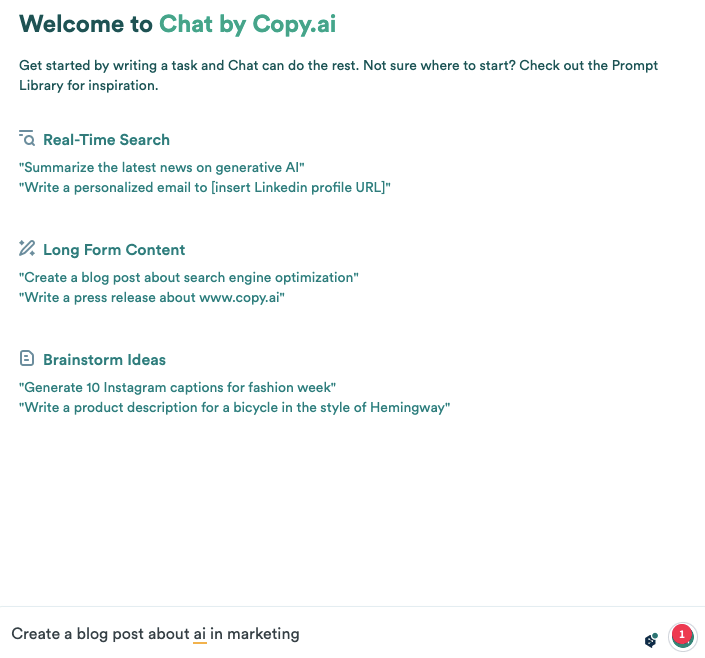
Enter a prompt describing the content you want, and your content gets produced within seconds:
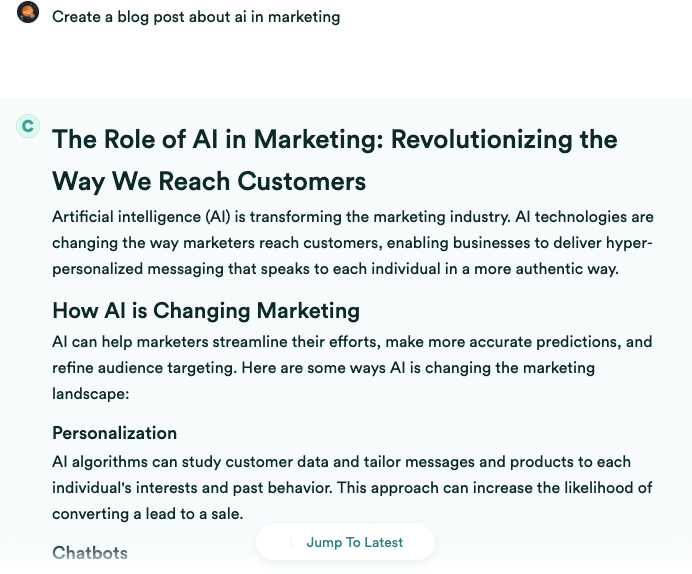
You can use this tool across plenty of areas, blog posts, headlines, social media copy, and more, to make your content creation process easier.
If you're curious about other AI content tools, take a look at this article. Several tools can also help you tell whether a piece of content was written by AI or a human, and our article on that topic can point you toward tools that help identify a piece of content's origin.
Chatbot
Chatbots let users get information and take action through messaging. They've been around for years, built on natural language processing (NLP), and they help customers and site visitors get answers to their questions. Chatbots can handle repeated questions and help resolve user problems.
In research from Drift, respondents were asked what they'd most want to use a chatbot for. Their answers included solving a problem, getting a detailed explanation, and reaching a live agent quickly.
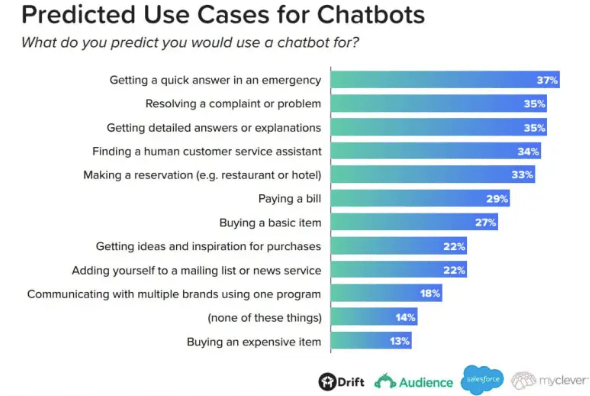
Today, chatbots show up constantly in banking, e-commerce, healthcare, and call centers.
Looking at Drift specifically, its chatbot is trained to answer questions outside a pre-programmed path, so users can get answers even to questions that aren't loaded into the system. You can try Drift's chatbot and sharpen your customer experience by developing your own AI model with GPT.
Email Marketing
Using AI in email marketing helps you enrich your content and analyze your list. It lets you build useful campaigns in less time, and the tools available in this space help you write in the right tone with AI's assistance.
Here are a few ways you can bring AI into your email marketing strategy:
- Determining subject lines with AI and increasing click-through rate
- Preparing personalized email texts
- Predicting future transformations by analyzing the past
- New customer acquisition
- A/B testing
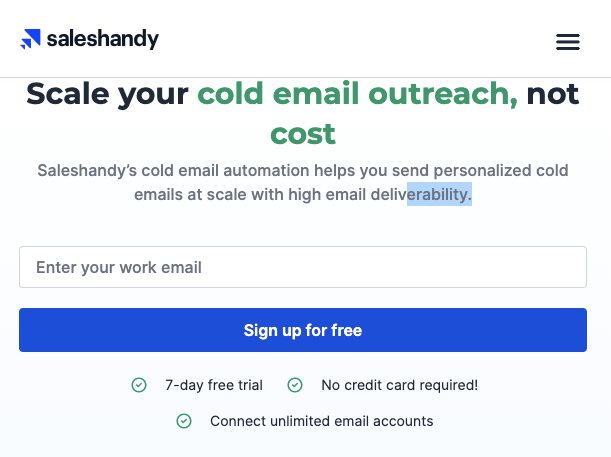
All of these help with engagement, conversion, sales, and revenue growth. Take a look at SalesHandy if you want to make your email marketing AI-powered. SalesHandy is built for cold emailing, letting you create email campaigns, prepare outreach for potential customers, write subject lines, and test different email variations.
SEO
One of AI's biggest contributions to SEO is optimizing content for search engines. AI algorithms can analyze a website, surface keywords that could help improve rankings, and track competitor activity.
Using AI-supported tools for effective keyword selection lets you spot your site's strengths and weaknesses and pick keywords accurately, using tools that measure how competitive a given term is. For original content production, AI-supported tools can help you create meta titles and descriptions, blog content, and plenty more, though editing a text after reviewing it tends to give better results than generating the whole piece with AI from scratch.
Adapting your SEO strategy to AI can optimize your workflows and produce stronger results. Reviewing this article on using AI in SEO can show you how to bring it into your own strategy.
You can also try Wope, our tool for SEO keyword analysis, website performance analysis, and tracking various indicators, to make your content marketing and SEO work more effective.
About Prompts
Prompts are the inputs humans give to guide the AI, and how well you develop them affects the quality of what the AI produces. At this stage, we'll try a few sample prompts in Writesonic and look at the results.
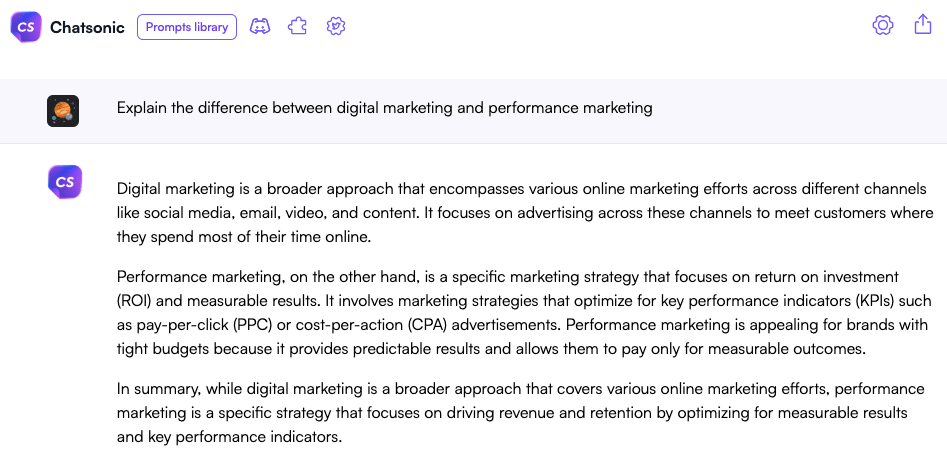
In the prompt asking it to explain the difference between digital marketing and performance marketing, we get a very detailed, explanatory answer.
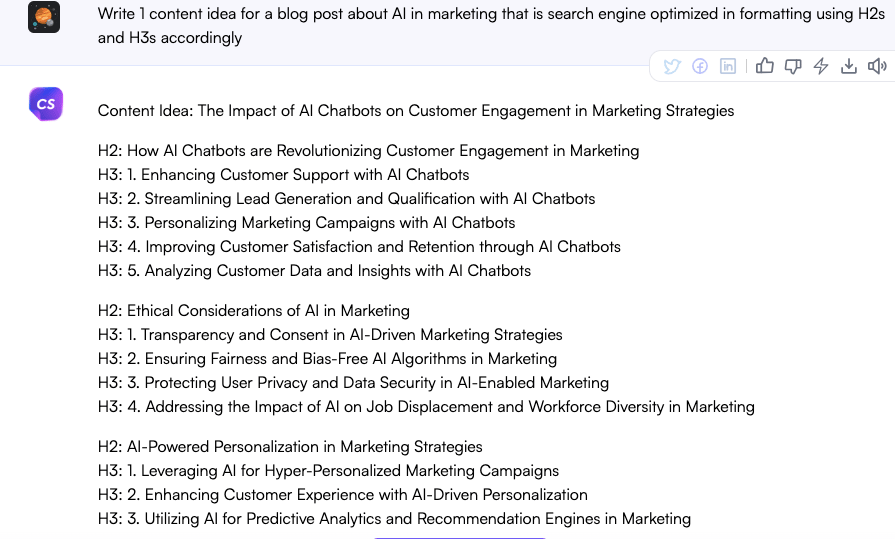
The more detailed the prompt, the higher the quality of the output. That's why we get the results above once we enter a more detailed prompt: "Write a content idea for a search engine-optimized blog post about artificial intelligence in marketing, using H2 and H3 appropriately." You can see the result is genuinely usable as a blog post.
Prompts also let you create images, not just text. Let's look at a couple of examples together with the Freepik AI Image Generator:
Here, we're aiming to show how results change across two different prompts.

Prompt: an impressionist painting of a woman sitting at a table and drinking coffee, rich, bright, spirited

Prompt: an impressionist painting of a woman sitting at a table and drinking coffee, peaceful, calm
Swapping "bright, rich, exuberant" for "peaceful, calm" changes everything. Refine your request further, and new descriptors can get you very different results.
We've now covered the basics of how AI works, so let's turn to its limitations.
Limitations of Artificial Intelligence
Limited Understanding
Models trained on a large dataset can learn patterns in human language and make predictions from that data, but they can't grasp nuance the way irony, metaphor, and sarcasm require. Idioms and cultural codes are difficult for AI too, though models trained, or being trained, in this direction will pick up on language over time.
Lack of Common Sense
AI still can't apply common sense reasoning to situations, because it can only predict based on the data it was trained on. Faced with genuinely new situations, AI tends to produce erroneous results. For example, an AI trained on object recognition may fail to identify an object it hasn't seen before, which brings human input back into the loop.
Bias
AI systems can carry forward biases baked into their training data, introduced through things like sampling bias or social and historical factors. For example, an AI trained mostly on data from female job applicants is likely to give less accurate predictions for male applicants.
These are AI's main limitations. AI systems are only as good as the data they're trained on, which is exactly why errors show up in the content they create, and why human oversight still plays such an important role.
Advantages and Disadvantages of AI Marketing
Advantages
- Increases profitability (ROI)
- Improves customer relationships and experience
- Enables you to create more efficient strategic marketing plans
Disadvantages
- Inconsistency in content quality
- Privacy concerns
- Non-measurable KPIs
Advantages
Increasing Profitability (ROI)
One goal behind using AI in marketing is boosting return on investment (ROI) and building campaigns that are easy to follow. The insights AI provides can sharpen your marketing planning, so folding AI into your workflows saves your team time and helps you earn more.
Customer Relationship and Experience
Another advantage of AI in marketing is what it does for your customer relationships and experience. AI's personalized recommendations increase the odds of repeat purchases, and it can also flag customers likely to abandon their purchase, letting you build campaigns to bring them back.
**Efficient Strategic Marketing Plans
**
AI use in marketing keeps growing in popularity. As your company and team grow, scaling gets harder, and using AI to analyze and predict your marketing assets makes that scaling easier for both.
Disadvantages
Content Quality
Letting AI produce a piece of content start to finish can hurt content quality, which is why you need to edit whatever AI creates. How well AI performs at producing content depends on the dataset behind it, so human oversight matters for keeping the content on-brand and free of mistakes.
Privacy
AI may need to examine a customer's cookies and browsing behavior to predict purchases and similar signals. If you're using AI software for this, you can protect customer privacy by staying compliant with privacy laws like GDPR.
Unmeasurable KPIs
Some metrics are easy to track once AI is part of your business, but others, like improving customer experience or raising brand awareness, are harder to measure. Having the right measurement tools in place matters here.
Now that we've walked through AI's advantages and disadvantages, let's look at some examples of brands using it in their marketing.
AI Marketing Examples
Amazon
Amazon was among the first companies to use AI to sharpen personalization in shopping recommendations and improve the customer experience. Its AI algorithms recommend other products based on a customer's past purchases and search behavior.
In this context, Amazon launched its AI assistant, Alexa, in 2014. These devices let customers find products and complete purchases by voice, along with getting reminders about past purchases.
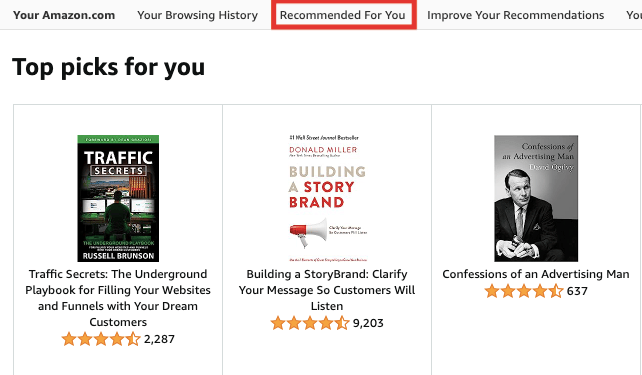
As you can see in the image above, the "Recommended For You" tab compiles suggestions based on your past search data.
Used this way, AI helps Amazon increase conversions and improve customer satisfaction.
Coca-Cola
Coca-Cola uses tools like ChatGPT and DALL.E to improve its marketing and operations, through a new partnership between Brain & Company and OpenAI. Using AI for personalized ads and buying experiences, Coca-Cola launched a vending loyalty program for customers in Japan through a smartphone app. Customers who download the "Coke On" app earn points every time they visit a vending machine by connecting their phone to it, and can redeem those points for future purchases.

(image source: adweek.com)
Artificial intelligence also shapes different purchasing strategies in Australia, the US, and New Zealand, where customers can pre-order two drinks through the app and pick them up from the machine.
Netflix
Netflix uses AI to recommend personalized content based on what viewers have watched and liked before, and its algorithm can genuinely lift sales through those personalized recommendations.
Netflix explains how its recommendation system works on its tech blog. If you've watched many movies featuring a particular actress, for example, it'll recommend other films where she plays a different role, and if you watch a lot of comedy, it leans toward recommending more of that genre.
Let's look at how Netflix might recommend "Good Will Hunting" differently to a viewer who prefers romance versus one who prefers comedy:
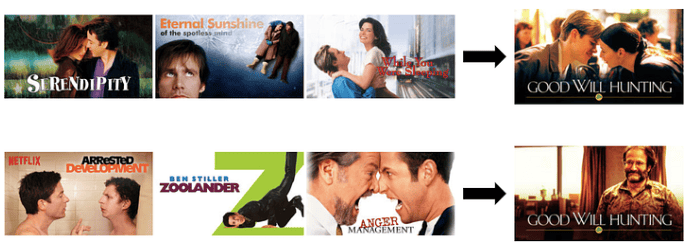
(Source: Netflix Tech Blog)
Netflix's reasoning for using AI this way comes down to improving the customer experience and raising conversion rates.
Spotify
Spotify takes a similar approach to Netflix, using AI to build recommendations from a listener's music taste, podcast preferences, and purchase history, which results in customized playlists and recommendations for each user.

Content personalization is a big part of what makes major media companies like Spotify so appealing to use. Spotify also uses AI to send personalized emails, aiming to deliver tailored messages that drive conversions.
Sephora
The world-famous cosmetics brand Sephora is a strong example of AI use in the cosmetics industry, offering an efficient shopping experience through the AI tools it uses:
Chatbots: A chatbot that makes it easier to get information about products and services
Sephora Visual Artist: Gives customers a virtual makeover they can share with others, helping them find the right cosmetic shades without visiting a store.
Color IQ: Analyzes skin tone, assigns a Color IQ number, and matches customers with the right foundation.
Fragrance IQ: Lets customers smell perfume fragrances without trying them on, through a dry-scent partnership Sephora built with Inhalio.
Through these services, Sephora is helping pave the way for AI use across the cosmetics industry. To see how Sephora's Visual Artist tool works, check out this content.
Final Word
The big brands covered here have integrated AI into their businesses for years and seen real results from it. Finding the right way to bring AI into your own company and team will help you get there too.
In this article on the use of artificial intelligence in marketing, we've compiled a lot of information about how you can integrate AI into your business and your team, along with the opportunities and limitations that come with it. Stay tuned to our blog for more on what's next in AI, and we hope this has been useful content for you!
This content was created by Nursena Küçüksoy, Marketing Specialist at Zeo.


