


We've put together this comprehensive guide to content marketing by drawing on many different sources and our own experience. If you notice any gaps in this guide, don't hesitate to let us know.
What is Content Marketing?
Content marketing is a strategic marketing approach built around creating consistent, valuable, and relevant content for a previously identified user audience, with the goal of mobilizing that audience.
As you may have noticed, the keyword in this definition is “value”. That word is what sets content marketing apart from other marketing and advertising methods. If users choose to follow or benefit from something rather than ignore it, that something belongs to a content marketing strategy.
Content marketing shouldn't stop at providing “valuable” content; it also needs to motivate users to take action. This action can be anything that brings value to your brand: Your users can share content within their network, subscribe to your newsletter, buy your products or give feedback. That's why widely preferred channels in content marketing activities include social networks, blogs, visual content and tools such as e-books or webinars offered to specific users.
Content marketing is perhaps one of the most useful among the versatile tools of digital marketing. It can take on different subjects or formats and adapt easily to any stage of the sales process. But that versatility can also lead some marketing experts into the trap of producing content just for its own sake. That's why a content marketing strategy needs to be established: it's what gets you to the content's real value and long-term goal, making it possible to obtain ROI (return on investment).
Content marketing is not a process carried out with advertising content that does not seem like one. As Joe Pulizzi, the founder of the Content Marketing Institute said: “Content marketing is not about “what you sell”, it's about “what you stand for”. So content marketing is not about what you sell, but what your brand represents. When applied correctly, content marketing is the best way to create a bond with customers. When you apply the right content strategy, you gain trust and respect in the market. Your company gets positioned at the center of the discovery and purchase cycle, giving you a direct influence on what users see, read, and think.
The concept behind an effective content marketing strategy lies in telling stories that may interest people. Your content should not be seen by your users as a “marketing” or “sales” item. This is how you make it possible to sell more by “not trying to sell”! Your content should aim to promote your brand and increase its sales, as well as to help your customers, produce the values they find useful and meet their needs.
This will allow you to reach and influence more and more people. Used this way, your content marketing strategy becomes the most powerful tool that sets you apart. If you answer “Yes” to the following questions, then content marketing can help you reach these goals from the top to the bottom of the pyramid.
- Want to improve your reputation?
- Are you aiming to expand your social community?
- Looking for new resources?
- Would you like to increase the number of users who are subscribed to your list by email?
- Do you want to carry out your communication with your brand identity?
- Do you want to turn your customers into regular customers?
- Want to create an audience specific to a niche?
In each content you create, it is also important that you reveal what you are targeting. This will not only help you determine the goals of your future content but will also help you keep track of existing content and measure their success.
Why Do Businesses Need a Content Marketing Strategy?
Understanding why businesses need content marketing is probably more important than knowing what it is. Content marketing can feel like a huge burden compared to marketing methods with very fast returns, such as list purchases, PPC (pay-per-click), or expo promotions where you can get a name and email address in seconds. Businesses often turn to content marketing when they find these methods ineffective, too expensive, not applicable, or all three at once. Let's take a look at the following examples that show the difference between a content marketing strategy and other methods:
Say you're using PPC as your primary tool to build the customer pool your business needs. If you want more followers, say you bid $ 2 per click on that keyword. After a campaign that runs for months, you've brought in 1,000 customers and spent 20.000 USD in total. What about the next month? You'll have to pay the same cost again next month, and this will continue in the coming months. This is what it takes to keep getting customers with PPC: when you stop paying the piper, customers stop coming. The same holds for other channels and methods you use to obtain customers, such as buying lists or expo promotions. Now let's look at the opposite of this situation and talk about using a blog.
Let's assume that your visitor-to-customer conversion rate on your blog is the same as in your PPC campaign and is 2%. This means that two out of 100 people who read your blog post in the first month become a customer. The difference between PPC and a content marketing strategy is that you don't have to make the same effort in the same field in the coming months. On top of that, the content keeps contributing to traffic directed to your site over time, and it's not just that one post: every blog post you write keeps functioning the same way.
In other words, content marketing builds businesses on predictable, scalable and inexpensively directed traffic. It does not require you to make the same investment every month.
Content marketing contributes to other marketing channels. It provides additional content for social media marketing and contributes to SEO by creating natural internal links. Moreover, your site becomes more visible in search engines with more quality content. We can even say that many companies' SEO work should really be carried out depending on their content marketing strategy.
Where to Start a Content Marketing Strategy
Below is the life cycle of a content generation process. We will discuss the steps of this life cycle later in our article.
Every successful content marketing strategy is based on two steps. These include:
Defining objectives Task definition
These two basic elements are the key elements of content marketing. Because they not only let you decide what kind of content to produce, they also help you understand what kind of content you should not produce by evaluating content projects from a business perspective.
In her book “Content Strategy”, Kristina Havoron, one of the industry's most successful names, presents the structure that you can see below to create a content strategy and mentions that this structure can be applied to both digital and offline content production. It also sets out exactly what you need to consider when creating a core content strategy for your business. In the gray-stained region, you'll find the content-related components, that is, the definition of objectives, while in the red-stained region you see the human side, meaning the task definition part of the basic content marketing strategy. Now let's delve into some of these interconnected sections.
Content Components: What, Why and Where Questions
The substance is the component that forms your basic strategy, where you determine what content your business needs and the main messages it wants to deliver. Substance should be based on the goals of your business and the interests of your target audience, and it determines how you source and shape your content.
Audience profile you want to access
- What will the audience receive from your content
- What you want to talk about
- What is the main idea behind each section?
- What is the source of your content?
The second part of the infographic related to content is Structure: the component covering your content's format, editing, and display. The questions you have to ask yourself about the structure of your content are as follows:
- What formats will your content have?
- What channels should you use to reach your target audience?
- How will users use your content?
- What are the most ideal channels to contact your audience?
- How should your content interact with other content?
- How to use metadata and other tags?
Once you have established the basic structure of your content according to the criteria listed above, it will be much more useful to direct the following questions to both yourself and the users so that your content can appeal to users more.
- What are the two or three most important things people who come to your site or content want to learn / find or do?
- What are the top 2-3 things you want users who come to your site or content to learn / find or do within your site?
Your answers to these questions become the most important questions in the structure of your site and your content.
Human Components: How and Who Questions
Workflow is about mapping out your content production process, identifying the tools you want to use, and identifying the people who run content marketing strategies that can successfully produce high-quality results.
- Who should be responsible for this in your team?
- How realistic are the time intervals to create content?
- Where will your resources come from?
- How will your content be published and will it affect the site format?
- At what stage will your content need to be reviewed and approved?
The last part of the infographic is Governance, which is about who should make important decisions about your content or content strategy.
- Who is responsible for your business content strategy?
- Who is your strategy officer?
- Who determines the format and style of the content?
- Who is responsible for the evaluation and review in the final stages?
- Who determines the workflow and process?
- Who is responsible for measuring the success of the work?
Research and Analysis
The first step in the content marketing cycle, research and analysis, lets you determine whether and how relevant your content is to your target audience and business needs. Whatever your company's goals are, your marketing strategy and your content marketing strategies should all focus together on one or more goals. When determining the content strategy, it's important to know your company's marketing strategies on different sources and their basic approaches in these marketing strategies. That way you can support content marketing strategies with the story that underlies each marketing theme and reinforce the expression of your brand.
1. Getting to Know Your Site
If you are not creating a new site from scratch or continuing from a small site, then you should start by reviewing your previous content. When you're aiming for a new content strategy, it's very important to make a detailed evaluation within the site, since that gives you a sense of your site's current structure and quality.
If you want to make a quick and basic assessment of parameters like traffic volumes and performance, you can build an inventory of your content. This inventory may include features such as the location of content, formats, page types, traffic, bounce rate, social sharing, and links. You can also add parameters such as word count, readability values, author and date.
2. Get to know your audience
At this stage, you need to identify the audience you're creating your content for. That means working on what the audience needs and how they can interact with the content. To really understand your customer profile, it helps to examine them almost as closely as if they were members of your own family. Here are some questions you may ask yourself to get to know and build your target audience:
- Where can you find your online audience?
- What attracts your audience's attention the most?
- What content topics and formats do they share?
- Do they have a sense of humor?
- Which newspapers / magazines / sites do they read?
- Who influences them?
- What is the right time to communicate with or reach them?
The best way to ensure that your marketing efforts are reaching the right people and getting them engaged is to dig deeper into your research. The methods that can be used for this can be found in the image below, including descriptions of approaches such as site analytics data, creating specific focus groups, and managing destination pages.
3. Identify the leading people in your industry that affect your audience.
People and organizations that have a positive impact on your target audience in your industry are key names in content marketing, and it matters to know what they're talking about. People with this kind of influence can be found in many places, from famous bloggers and journalists to industry experts. If you intend to research them on social media, we can recommend Moz's Followerwonk tool. With this tool, you can identify people with authority who follow you or your competitors, compare your audience, see top tweets, and determine the right time to reach them.
4. Investigate your competitors in detail
Keeping track of your competitors can improve your marketing efforts and content production across the board, giving you a sense of their strengths and weaknesses. Some things to consider at this point are:
- How are sites and their content shaped?
- What topics do they convey?
- What content formats do they use?
- How do they position their brand identities?
- How do they relate to their digital community?
- Are the contents successful?
There are several different ways to investigate your competitors.
When analyzing a competing site, you may follow methods similar to the methods you apply to your site.
With tools such as Buzzsumo and Ahrefs, you can identify the most linked and shared content on your competitors' site, as well as the social media channels where their content performs best. You can also set up alerts with tools such as Google's alarm service or Talkwalker to keep you informed of your competitors simultaneously.
Planning: The Most Important Step of Your Content Marketing Strategy
So far we've set our goals and completed the necessary research, so the next step is to develop the plan. When it comes to putting the data you've collected into practice, it's worth remembering what Colleen Jones has said about this issue:
"The data you have are your eyes, not your brain"
Creative planning means taking the data and constraints you have and, after applying or transforming them, turning them into a product or multiple products carrying a specific message.
This process of pulling together input from these different fields brings designers, researchers, team members, and the developers responsible for creative processes together to develop new ideas.
1. Generating ideas
Creating stories that fit your target audience and purpose is very difficult. Your starting point should be the issues your target audience raised during your research. It may be difficult to determine how you will present the arguments found in your content once you've settled on the topic. The experts' suggestion for this is to identify the arguments you'd actually talk about when chatting with friends. If your content manages to spark offline conversations instead of staying purely online, that's a good sign your choice of topic is solid. If you think you're in a deadlock, we recommend that you carefully read the following three approaches:
- Uncover an unknown and surprising subject related to an experience.
Look at the “Why? behind an event, norm, behavior, concept, myth. Even better: correctly disprove common assumptions!
Tell something about a social norm, a famous product or concept that your audience doesn't know. This will be content that lets you spark conversations offline too. An example of this is the infographic from the popular and simple The Renegade Pharmacy, which went viral. In this infographic, the pharmacy answers the question “What happens one hour after drinking coke?”
After this infographic was published, many sources started to prepare infographics about the effect of our favorite foods on our bodies.
- Produce identity-based content that tells readers something about themselves or about people they know.
We can give an example from Buzzfeed's British editor, Luke Lewis, who recounted a memory in his viral content activity: an article about a man who goes to Australia to see a little girl with Treacher Collins syndrome, who has the same genetic disease as her. The article performed poorly at first, until he added one decisive element: that he's from Yorkshire. After this decisive item, this content went viral.
The reason for this was that readers in Yorkshire feel closer to the subject and are more likely to share this content with their network. After these shares, the network grew steadily, making the content viral.
- Use the nostalgia card
Nostalgia was once considered a psychological disorder. But today it is believed to be a neurological defense system. The longing for the past is universal, so it's no surprise that nostalgia works so well for reaching a wider audience.
2. Determining content structure and formats
Conducting content marketing can make it feel like conducting an orchestra, organizing a wedding or preparing a show for the stage. It's a known fact that content marketing strategies built around structured, well-formatted content see a much higher success rate compared to marketing strategies without that kind of structure. As mentioned in the content Builtvisible, which we have benefited a lot in our content here, you can say that the structure of Curata's Content Marketing Pyramid is an important guide at this point. The Pyramid of Curata consists of five different levels with a total of three layers. Let's examine these layers separately.
- Level 1: Basic content
Basic content, by its very nature, involves research and understanding, and assets are produced from these basic contents and experiences. We can give Books, e-books and guides as examples of the contents which we call assets at the top of the pyramid.
These assets serve as a source for the lower parts of the Pyramid as well as providing a transition to them. All assets in other parts of the pyramid aim to direct your visitors to these core assets and turn them into customers.
- Level 2,3 & 4: Derived assets
Assets in the middle of the pyramid are assets derived from the Basic Contents. With these tools, it becomes possible to present some of the basic content in smaller parts and focused more on specific features. This content is easier to access than others, and can come in a variety of formats:
- Long blog posts, presentations, infographics, and SlideShare (Level 2 & Level 3)
Depending on your main income target and growth strategy, this type of content is not aimed at generating revenue directly. This type of content is edited to reach the user directly, no matter what level they represent, with the aim of redirecting them toward the content you plan on earning revenue from.
- Blog posts and distributed content (Level 4)
We can say that the content contained in Level 4 should be produced more widely than Level 2 and 3 content. It becomes part of the content production process on a weekly, if not daily basis, and serves as a different kind of tool for your content marketing strategy. We can say that this type of content is “bread and butter” for content marketing strategies. With distributed content, you aim to direct users to your core content using different media sources.
- Level 5: Micro - contents
At the bottom of the content marketing pyramid is the micro-content, built on promotion and communication. Level 5 content aims to push awareness, consumption, and action-taking to the highest level for all your other content. Social media sharing is an example of Level 5 content.
3. Writing plans
Each content marketing effort should have at least one basic asset (a sellable asset), a large amount of micro-content, and a few subsidiary assets derived from that basic asset. Planning and documenting all of these assets is necessary to get the most out of content marketing. For marketers looking to publish a new blog, it's important that the process is written down and planned, based on keyword and user research, to set it up for success.
When creating your to-do list, keep in mind that low-priority assets and micro-content need to be planned flexibly. That way, you can adapt your content by following trends and events related to your basic asset and brand position.
Production Phase
Depending on your company's management structure and your content, your content production process should be built around a structure similar to the following:
- As you can see in this structure, the content publishing process goes through not only production and publishing but also different evaluation stages. It's important that content reaches its target by being published under the review of interested people who bring different experiences and work in different departments.
Quality content instead of large quantities of content
When you start producing your assets, always put quality ahead of quantity. According to a recent survey by Acrolinx, 59% of users prefer not to shop from a website with bad grammar and spelling mistakes.
Source of your content
Although experts in the content marketing and digital marketing industries have different opinions on this issue:
- according to Curata, 65% of your content should be original, 25% should be arranged from different sources and 10% should link directly to other sources.
- The Huffington post takes a different approach, suggesting ratios of 30% source editing, 30% original and 30% experimental results.
Whichever method works for you, content collected from different sources is an important, common component of any content marketing strategy.
Curated - Collection content
Collection content simply means using excerpts, small sections and certain parts of content from other sites without infringing any license. Using such content within your site in a way that's specific to your own content lets you do this without license infringement. Buzzfeed is one of the largest implementers of this kind of content on the internet, thanks to the lists it creates. With collection content, you can gather and use a large number of images, articles, anecdotes and quotes. The key point to pay attention to is that you have to provide a link to the source you took the content from, and that you use only a part of the content in question.
Licensed content
Licensed content can be quite expensive, in contrast to aggregate content, but it gives you the right to use content written by a professional journalist. It requires less manpower than producing your own, and it's reliable and held to a high standard.
User Generated Content
Placing the content created by your users at the center of a content marketing strategy is a highly effective way to promote your brand. User-generated content is now more active than ever. With the increase in smartphones and social networking users, the number of people sharing photos, comments, art and online music is also increasing. Moreover, Nielsen says that users' comments on a brand are the second best source of trust and that people trust each other more than they trust in advertising or product promotion. That is why the content that users create can be quite powerful. These contents bring a different level of support and customer trust.
A lovely example of such content is Starbucks's White Cup Contest. In this contest held in America and Canada, users were asked to share photos of their artistic designs using Starbucks cups. The winning design is printed on a limited number of Starbucks recycled cups to be sold. With nearly 4,000 people participating in the contest, we can say that Starbucks has generated a very large library of content created by users.
Spreading Content
The next step is getting your content in front of the right people.
In the research and analysis phase, you defined your strategy: where to find your users, what they like to read, and who inspires them. You should also know when they're most active online.
Before you start distributing your content, you'll also need to edit it properly, so it has the best chance of spreading on its own. From there, you need to submit your content to relevant publishers and reach out to people with influence, while also interacting directly with your users via social networks and email. Below is a list that can improve your chances of successfully disseminating your content.
Create Powerful Titles
Although “click-bait titles” created to pull you into clicking overwhelm everyone's patience, powerful titles undeniably help get your content seen. Create a few alternative headline ideas and test them on Twitter. Being a bit mysterious can help make titles more effective, but be sure to avoid using titles that mislead your users.
Optimize Your Share Buttons and Social Markers
Share buttons should be visible throughout your site. Buttons placed near the top of your content tend to drive more sharing, and it's possible to get more feedback through sharing buttons on social networks.
Targeted Meta Tagging
A clear, targeted title increases the likelihood that your content appears in top positions for relevant keywords in search engines. Adding a targeted title tag, meta description, and using keywords well also helps. Just be careful not to overuse keywords.
Create In-Site Links
In-site links guide visitors toward specific content. If a piece of content is especially important, linking to it from the home page is the most effective way to drive traffic to it. Links to relevant destination pages or popular content can also give users a reason to stay on your site.
Sign Up for Google News
If your site qualifies, adding it to Google News can lead to a significant boost in organic traffic performance.
Reaching Publishers
Reaching journalists and bloggers who cover topics you've already published on is one of the most effective ways to get your content in front of the right people.
Share on Related Channels
Send out a few tweets about your content the day you publish it, and keep doing so in the weeks that follow. Don't forget to retweet your older content to draw attention to it, too. Upload images to social networks like Slideshare, Instagram and Pinterest, stay active on YouTube, and regularly assess how you can reach your users through other popular social networks (e.g., Snapchat and WhatsApp). Emotionally engaging content tends to draw more attention on Facebook than on Twitter, though sharing the same content repeatedly on Facebook may not pay off the way it can on Twitter. Even though they aren't free, platforms like Outbrain and StumbleUpon can also help get your content viewed.
Reach Your Users Directly by Email
If your email list is segmented by user profile, you're in a better position to send content directly to the users it's most relevant to.
Evaluate Your Content in the Offline World
You can also put your content to work outside the digital world, especially if you want to reach a particularly influential person, such as a journalist at a specific newspaper. Printing out your visually valuable content, like infographics or photo series, is a good way to stand out from the crowd of content online.
Measuring Content Marketing Process & Monitoring and Evaluating Content
You're probably already familiar with your content strategy and its statistics. Your soft metrics measure interactions, returns, and brand awareness with your users, while your hard metrics cover sales impact and statistics from users who navigate to your site. Create a document that tracks all of this over time; a reference like that helps you evaluate the performance of different content marketing efforts and learn from your experience. Even a single spreadsheet is enough to get this done.
What to measure?
What you need to measure varies according to the objectives of your content. Assigning a value to actions that don't directly generate earnings (social interactions, email sign-ups, and so on) helps you measure the overall success of your work. Remember to set goals, and be sure to determine the ideal scores for each measurement.
Retracting Content
Content marketing is a long-term process. Don't expect big changes from the first few pieces of content you create. Building a reliable, high-quality source that embraces your brand's values takes time. That said, it's open to change, and it's worth adjusting based on how your content performs. If content isn't delivering the return you expect, don't hesitate to change your approach and try something new. In such cases, try different “call to action” alternatives, test different titles, and even consider changing your visuals. Is the content too dense and hard to read? Are there enough images? Ask yourself these questions regularly. A small change can have a big effect, just like Buzzfeed's Yorkshire example above. Feel free to make the right decisions at the right times.
Finding out who will manage your content marketing process
Content marketing requires manpower, so the first step is finding out who will manage the process. It's almost impossible to find someone who perfectly fits the structure of an entire team, and this will vary depending on the size of your company, your marketing team, and your budget. Still, assuming these three things are interrelated, it's possible to sketch out a framework for how other content marketing-oriented companies work, one that helps you hire the right person and position these different areas in your company correctly. If you are a self-employed entrepreneur, or if you are working with a single person for marketing, the responsibilities should be:
- Prepare content - text and oral, long and short (a blog post for all users and the like)
- Optimizing content on SEO basics
- Social media management
According to Mike Volpe: " In fact, the best way to help your sales team is to build brand awareness and create content that generates a lot of leads over time. An increase of twice as many leads means twice as many quality leads -- as long as you have software that lets you filter those incoming leads efficiently. That's how you build a successful sales and marketing machine”.
At this stage, the work of one or two content marketers, covering content preparation, SEO, and social media management, produces almost the same result as the work of a single person. As Volpe suggests, even if you hire two different people for the content marketing process, it's difficult to separate the responsibilities of two different employees. Both employees should contribute to these three obligations, and the content marketing process should be shared between them.
When your team grows, the division of labor can be:
- Blog Contents: Two employees
- Long / Premium content: One employee
- SEO: One employee
- Design: One employee
In a business of this size, there is usually a marketing manager with all these employees reporting to them. At this point, while the marketing manager manages the content marketing process, daily activities must be conducted by a team of five people. When it comes to a marketing team of around 20 people, your content marketing team will be run by employees of the same roles, bloggers, long content creators, SEO experts, designers, with the numbers simply doubled. At this point, you should appoint three employees from the team as bloggers and two for each other position. It may be wise to have one of the blog writers work as an editing expert, so that as activity increases, you have someone who can maintain the content's quality.
In an enterprise of this size, if you don't want hundreds of reports landing on your marketing manager's desk, you should also have a leader for your content marketing team. They adjust the budget, hire the right employees, contribute to content ideas, explore growth paths, and help ensure coordination among other leaders within the marketing team, so the content marketing process doesn't run haphazardly.
Designers must meet the demands of employees across all teams. That's what turns them into marketers who deal with the whole picture, rather than just focusing on the top of the pyramid. You can also hire content creators who can design on their own. People who can do ebook editing, create social media visuals, or handle simple, entry-level design work fit this definition well. Keep in mind that your content marketing budget includes agency fees and contracted design work requested by third parties when necessary.
Selecting the Team to Work for Content Marketing
Above, we've examined the different types of content marketing teams and the different professional groups you can work with. So, what do they do, and how do you choose the right people for these roles? To get started, you can review some basic job descriptions below, along with the knowledge and skills an ideal candidate should have. Your specific needs may vary. For example, you might expect coding experience or expertise in a variety of subjects from team members who create long-form content, or the job titles you need may change, and the “content creators” you're looking for might be “content strategists” or “social media managers” who are “experts” in this subject. Feel free to adjust accordingly. If you're hiring for any of these positions for the first time, the following draft can help you get started.
Blog Writer
We are looking for an expert writer who will join our blog editorial team. Candidates should be highly skilled and passionate about writing, with extensive knowledge of the industry. The blog author is expected to carry the company's voice across all blog content and to keep improving in this role.
Responsibilities:
- Writing on a wide range of topics for the blog
- Providing feedback to other employees and editing the content of different writers
- Optimizing content for search engines and ensuring the dissemination of content
- Conducting analytical projects to develop blog strategies / tactics
- Increasing blog followers and blog access
Search Qualifications:
- Curiosity and sensitivity to the sector and the mission of your business
- Compliance with the style, quality, and ideas for the different content types of your business along with excellent writing and editing skills
- Analytical intelligence and interest in data usage in the optimization / scaling process of blog marketing strategies and tactics
- Independent working ability and organizational skills to manage projects with many different dynamics
- 2-3 years of experience in marketing and content preparation
Long Content Creator
What you need here is a talented, productive content creator who can regularly produce and write project and blog content, expanding your company's digital footprint, awareness, and customer pool. This position calls for a high degree of creativity, a precise eye for detail, and solid project management skills.
Responsibilities:
- Create 1-2 free pieces of content (such as ebooks, promotional articles, data graphics, guides, etc.) each month to sustain clients, followers, awareness, and other important variables
- Regularly provide blog content that attracts site visitors coming through search, social media, and email, alongside support for other projects
- Increase the number of subscribers by regularly creating content that meets their needs
- Collaborate with designers, product marketing and sales staff, and industry experts to produce content that serves both stakeholders and your target audience
- Convince others that their ideas are worth the time and effort. This position forms the core of the marketing team, and other employees build their work around what you do every day.
Qualifications to Seek:
- Bachelor's degree or equivalent level of work experience
- Experience producing content for the internet, especially across different social media platforms (blogs, SlideShare, Facebook, Twitter, etc.)
- Online or offline experience growing an audience
- A writer who creates excellent, creative content should also be process-oriented, with multi-dimensional thinking skills and the ability to work with data for decision making.
Social Media Manager
- Someone who can grow the follower count, sustain that growth, and turn potential customers into active advocates and supporters of the company is ideal for this position. The social media expert should have a strong grasp of marketing best practices and trends, enjoy generating creative ideas, and know how to build a digital audience.
Responsibilities:
- Strengthening and managing social media profiles of the company on Facebook, Twitter, Linkedin, Google+, Pinterest and other channels (Snapchat, Instagram, Vine, etc.).
- Creating content suited to different channels
- Tracking conversations happening on social media about the company, the sector, or its competitors, and turning that into data
- Regularly producing social media campaigns and promotions and following up on their results, from Twitter chats to Google+ Hangouts or LinkedIn conversations
- Working in collaboration with other marketers and content creators to create content that will inform and entertain your target audience.
- Managing the traffic and customers from your social media presence stably and appropriately.
Qualifications to Seek:
- Bachelor's degree or equal work experience.
- Active and versatile social media use with mastery of each channel and its best practices
- Strong communication skills and creative thinking abilities to draw on both existing data and intuitive knowledge during the decision-making process
SEO Expert
The SEO expert is responsible for identifying and acting on opportunities that help the company and its content improve on specific keywords.
Responsibilities:
- Performing both on-site and off-site SEO practices of the company
- Working in collaboration with blog writers to create high-quality content suitable for SEO
- Running the SEO process and setting targets based on traffic, click, and conversion rate data
- Setting targets related to bounce rate and conversions
- Keeping track of the latest trends and changes related to SEO and major search engines
Qualifications to Seek:
- Bachelor's degree or equal work experience ranking
- Comprehensive knowledge of factors affecting organic rankings and optimizations, and algorithm updates
- Sufficient skills in web analysis and the ability to use keyword tools
- Excellent verbal and written communication skills
Designer
The designer is responsible for creating and protecting the company's marketing materials and products, as well as content prepared to support other marketing objectives. This person needs to bring the brand to life, from theory to practice, and keep it consistent across every touchpoint.
Responsibilities:
- Using the expertise and aesthetic knowledge to help bring out a new design and content ideas.
- Collaborate with long and short content writers to help revitalize their content.
- Preparing and editing templates for the team to make their posts more effective in social media, blog, email and other channels.
- When needed, meet other design needs such as presentations, signboards and trade show designs.
Qualifications to Seek:
- Bachelor's degree or equal work experience
- Experience as an in-house designer in a marketing agency (You must request past work examples from applicants for this position).
- Design experience suitable for mobile systems / tablet systems and desktop systems.
- Specialization in Adobe Creative Suite and similar programs (HTML, CSS and JavaScript knowledge should be preferred.)
Obtaining Appropriate Content Marketing Tools & Technologies
The good thing about content marketing is that once you have the right person (or people) to do it, you'll have almost everything you need. At this point, it may also help to learn some of the basic tools and technologies you can use to publish content.
CMS - Content Management System
A CMS lets your content marketing team create blogs and content without needing an IT department or software developer.
Serpstat's new tool automates and helps you create unique content that brings more traffic to your site or blog!
It generates headlines and descriptions from ready-made text, paraphrases text, and checks grammar and spelling errors. You can create your own articles from scratch or by extracting keywords from your existing text (or text you found while researching competitors).
Web Analysis Tools
To understand whether your content marketing performance is reaching your goals, you need an analysis tool for your website and blog. Some content marketing teams use Google Analytics, while others may prefer tools that let them measure their content marketing efforts based on earnings.
Project Management Software
With social media management and regular blog content creation happening at once, a project management tool matters too, since most of your content gets used across multiple campaigns and teamwork. For this, you can use the free software called Trello, which helps you organize your content, set deadlines, attach files, and collaborate with multiple team members. Zerys is another tool you can use to organize your content projects from planning to publishing.
Design Software
Visual content plays a major role in how well content marketing strategies perform. The Adobe Creative Suite program provides content marketers with everything they need for creating content such as ebooks, graphic design and social media images, etc. Design teams will often be using InDesign, Photoshop, Illustrator, and Acrobat. As a free alternative, you can try Canva. This software makes it easy for designers of all levels to create visual content such as presentations, cover photos, advertisements, and more.
There are various tools available for creating infographics, including Adobe's own infographic tool. We have produced a substantial amount of interactive content by utilizing their infographic creator, and we recommend exploring their free tool to see the value of using something specifically designed for creating infographics.
Content Marketing and Artificial Intelligence
Artificial intelligence has entered our lives very quickly, and thanks to AI applications bringing so many changes, the processes of planning, executing, and measuring our business have accelerated considerably. Naturally, this wind of change has also been reflected in content marketing.
So, do you know in which processes of content marketing you can benefit from artificial intelligence? Let's take a look together.
1. Finding Content Ideas with Artificial Intelligence Tools
It's often difficult to come up with a new content idea, because many content ideas have already been realized. But there is never an end to ideas: as long as life goes on, original content ideas will continue to be born and implemented.
If you think you have a hard time coming up with ideas, we have great news for you: you can find content ideas with AI tools. Whether it's a blog post, social media content, video, or e-book, whatever type of content you choose, you can generate tons of content ideas using the right tools, and in minutes!
Let's make an app and find content ideas with ChatGPT.
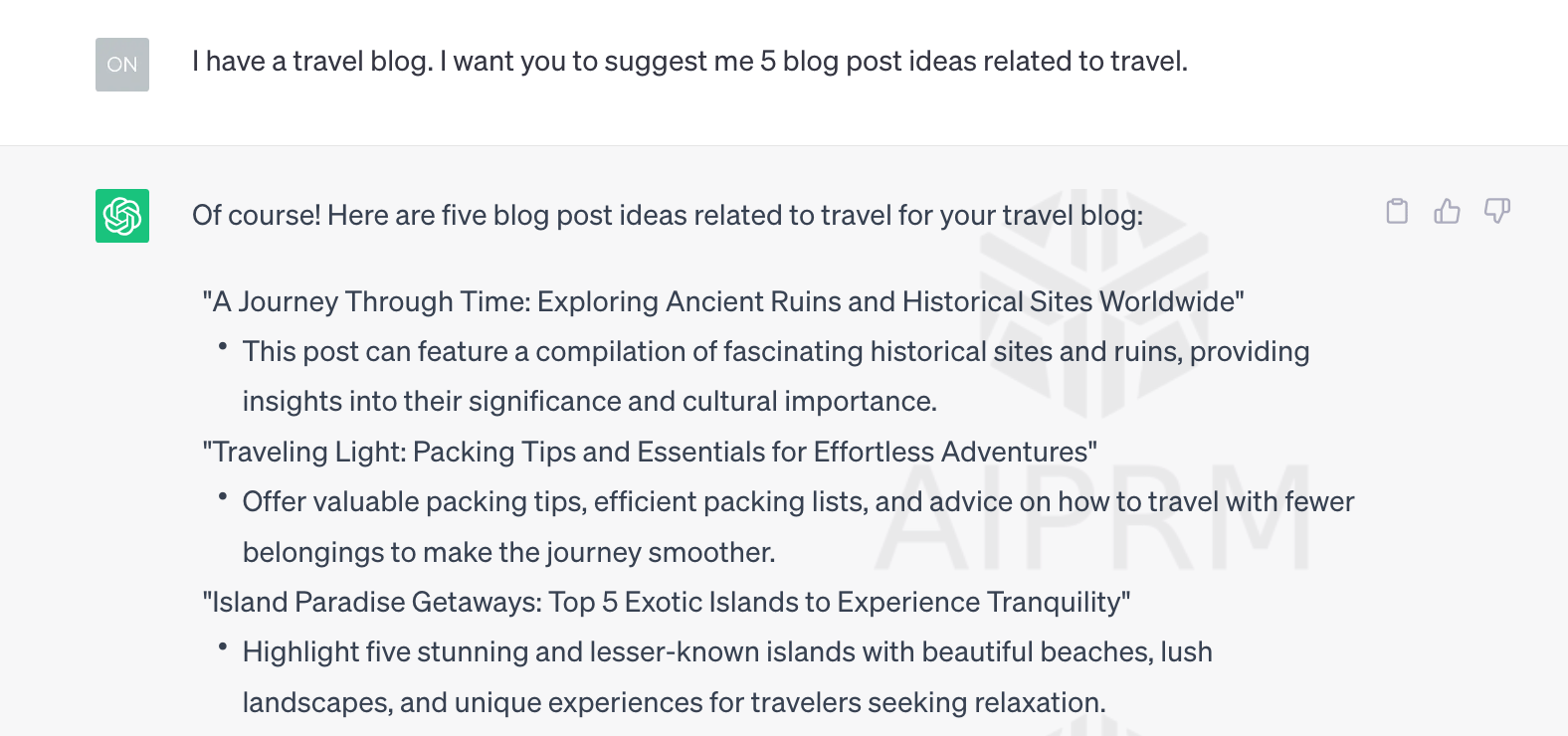
As you can see, we wrote a short prompt and it gave us the idea of instant content. You can also use Google Bard instead of ChatGPT; the choice is entirely yours. The reason why I made the prompt in English is that it gives better results in English, but you can also use it in Turkish. By entering the right prompts, you can generate hundreds of content ideas in minutes.
Moreover, you can increase your productivity even more by integrating applications like ChatGPT for work into Google Sheets. For detailed information about these integration processes and usage, you can take a look at our previous content on Social Media Content Optimization with ChatGPT for Work!
2. Creating a Content Calendar with Artificial Intelligence Tools
You've come up with content ideas, but as you can imagine, it's not enough just to come up with ideas. Putting them into practice in a planned way is just as important as coming up with content ideas!
There are many advantages of creating a calendar when creating a content marketing strategy, because this way, you can create a consistent content publishing plan, and that has a positive impact on your target audience.
So, do you know that you can create a content calendar with artificial intelligence tools? Let's show you with a small application!
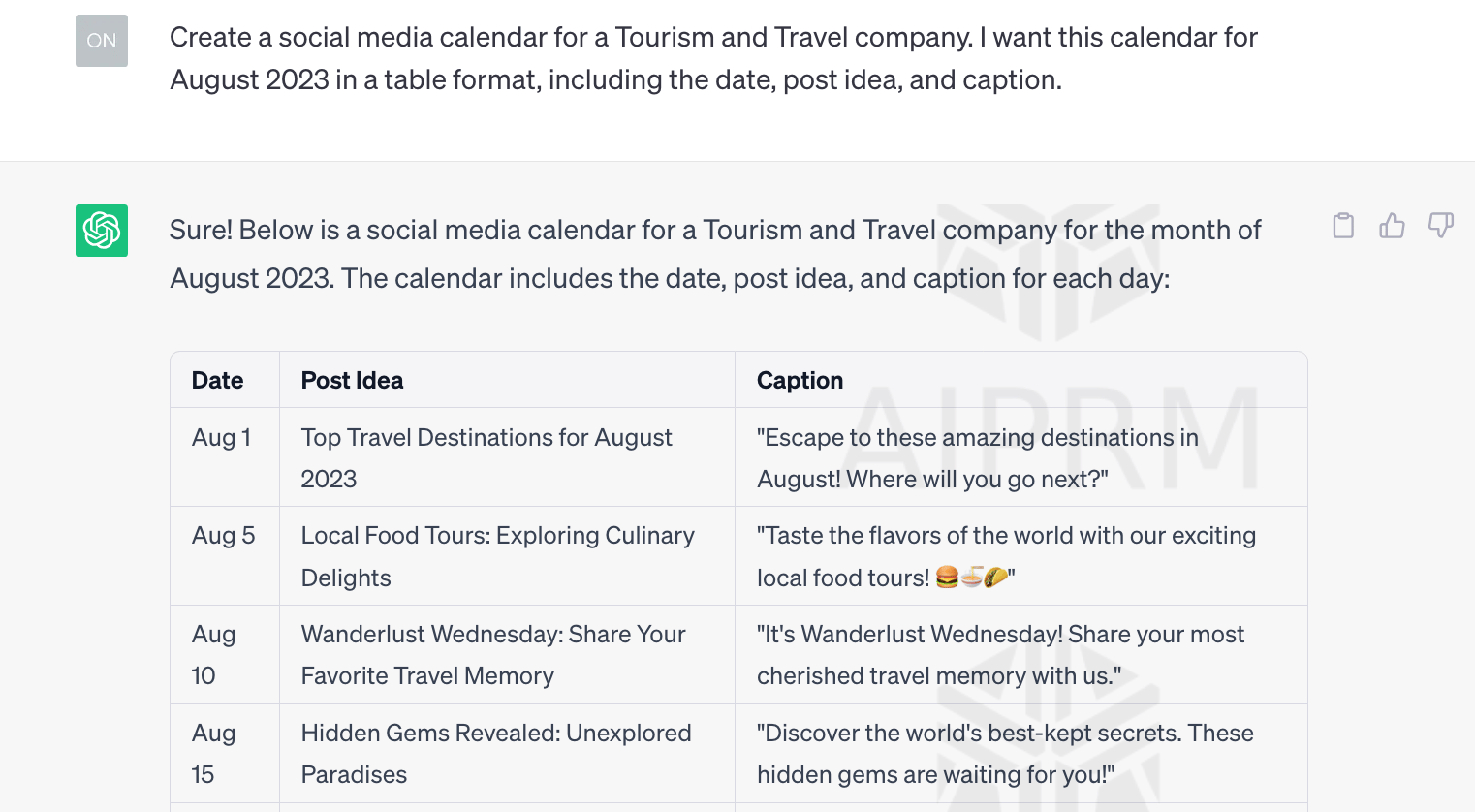
Simple, but effective. Very effective.
In seconds, we can create a content calendar with publication date, content idea and caption. Using this kind of content calendar, we can manage our content marketing efforts in a much more consistent and organized way. You can use it for your website or your social media accounts. You just need to enter the right prompts.
3. Creating Outlines for Your Content
Before producing a piece of content, you should always do detailed research and create an outline. Just answering these questions will speed you up a lot in this process:
- Which topics will this content cover?
- Which topics will these topics cover?
- What will we cover in detail under which heading?
It may sound like a tiring process, but with AI, you can easily handle this challenging process. How? Let's show you by preparing an outline together!
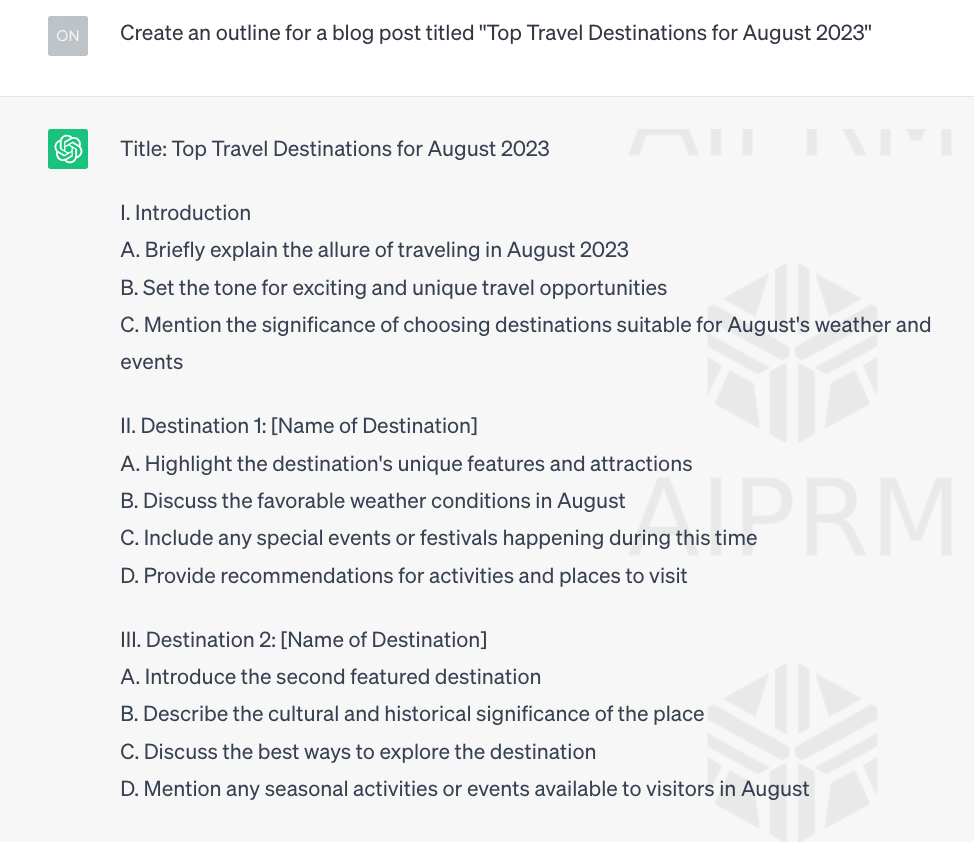
This outline will outline a piece of content we will create for the blog page of our travel-focused website. As you can see, creating an outline before producing content makes your job much easier, since you don't run into as many bottlenecks in the writing process. That's because you've specified in advance which topics you will address under which headings.
You can think of it as drawing your road map before you set off and following this map along the way.
IMPORTANT TIP: Creating an outline before producing content with AI tools will help you get much better results. Take care to create a detailed outline to get away from repetitive sentences and produce more effective content.
4. Creating Content with Artificial Intelligence
Now we come to perhaps the most important stage of content marketing: creating content. This stage is so important that unless you produce quality and effective content, all your efforts can be in vain. If you want to make a difference in content marketing, you have to create content that makes a difference.
With the development of artificial intelligence and the emergence of ChatGPT, there has been a revolution in content production processes. Various AI tools developed on the basis of ChatGPT have also started to be used in content production processes.
In fact, some websites have already introduced their AI-generated content to their users. At this point, you may also want to utilize artificial intelligence applications to produce content. So, how can you do this?
You have two options:
1. Use ChatGPT or Bard to generate content by entering the necessary prompts in detail. 2. Use paid tools such as Writesonic, Jasper, Wordtune, Rytr, etc.
In the first option, you feed the AI with prompts, deciding step by step how many words the content should be and what kind of style it should be written in.
In the second option, the process is easier, because such tools already use the ChatGPT infrastructure. Since the AI is trained by sending prompts in advance, all you have to do is fill in some options and produce your content that way.
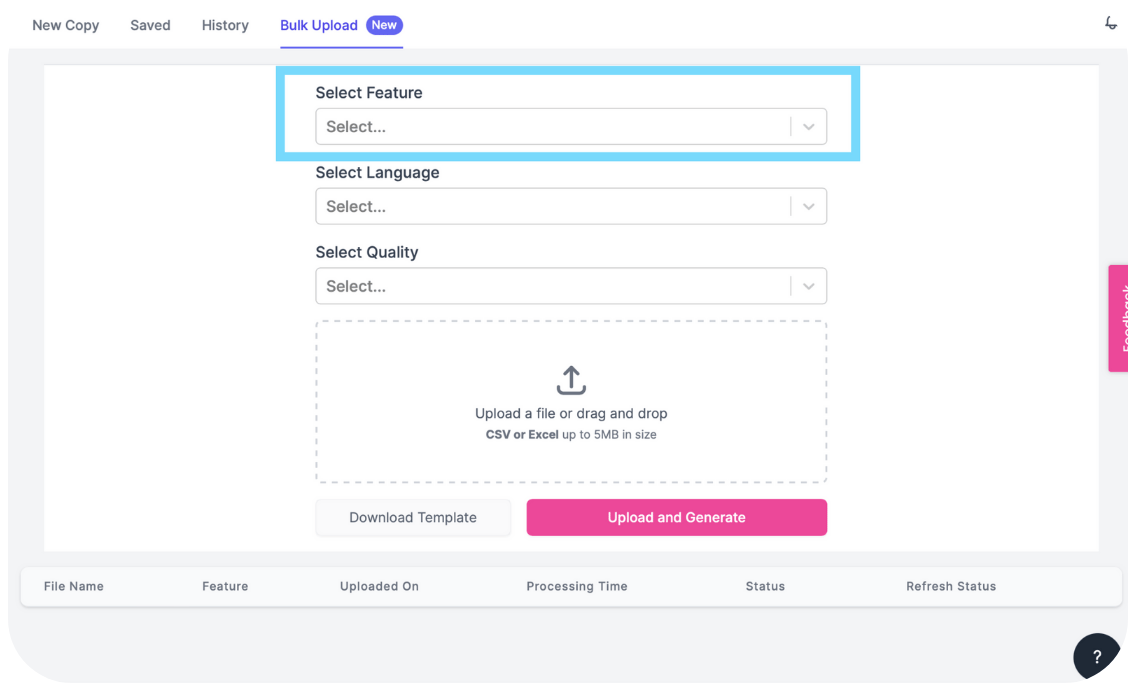
For example, the Writesonic tool includes the option to create content in bulk.
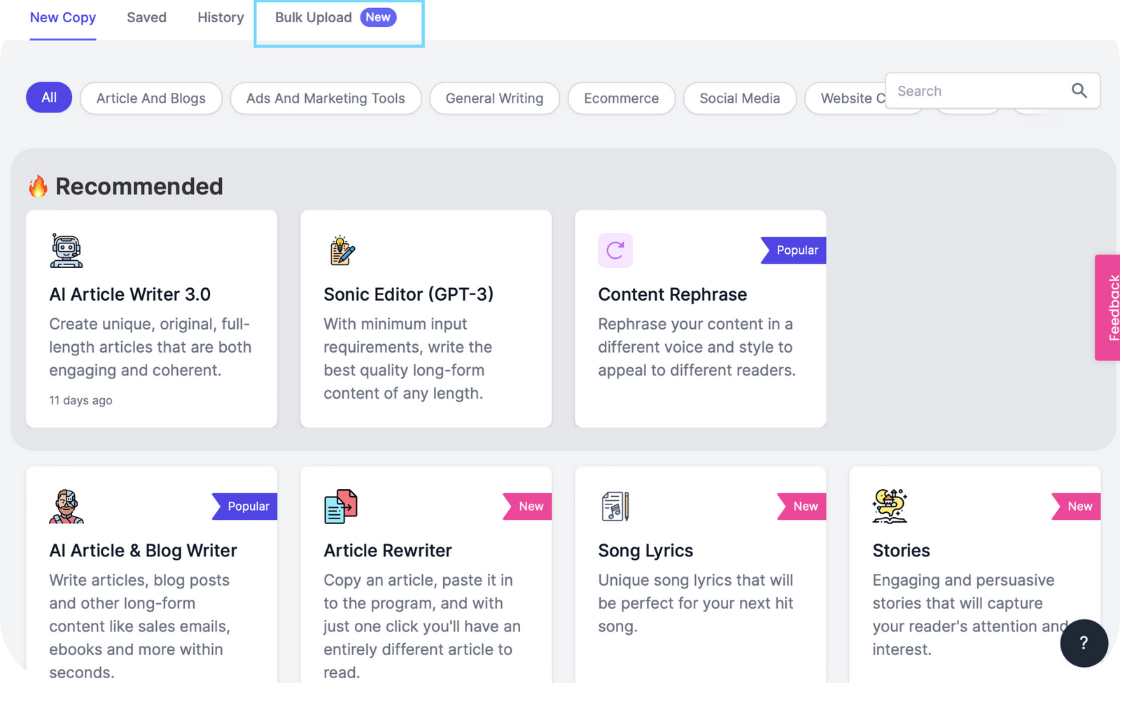
By choosing the language, features, etc., you have the chance to produce content more quickly, though of course these are paid.
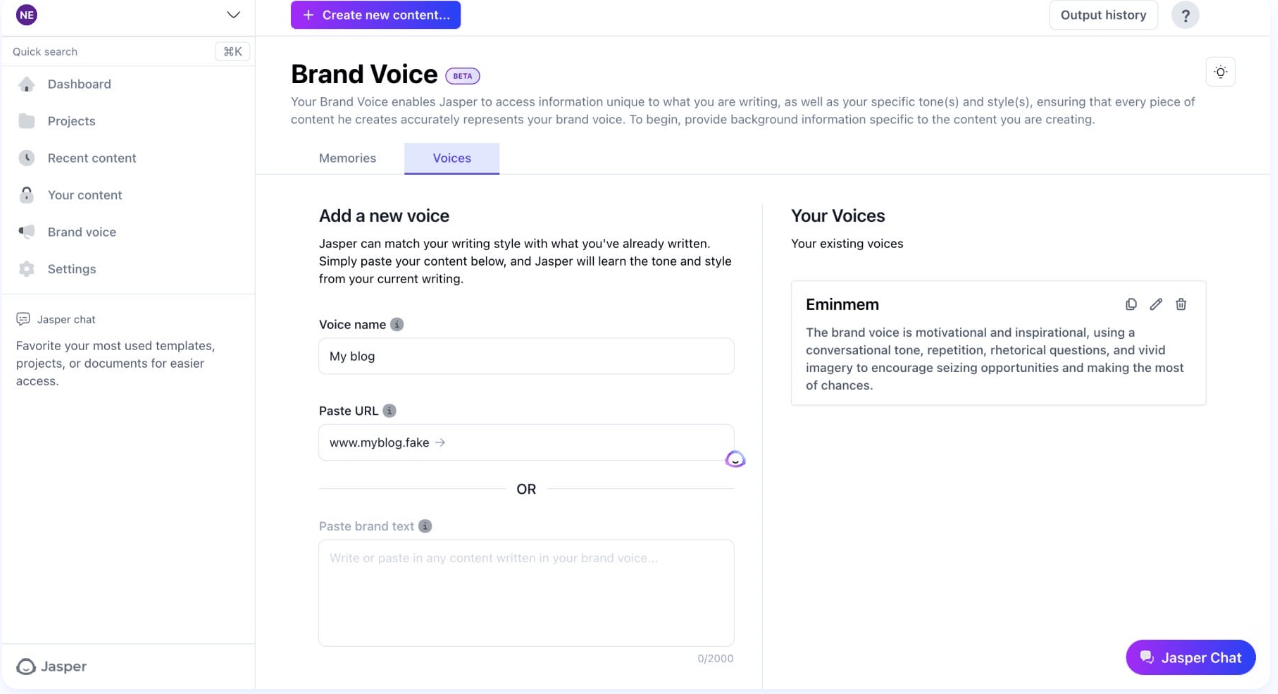
In Jasper, another similar tool, you have the chance to produce content close to what you want by filling in various fields. You can even choose the brand voice (the communication tone of the brand).
If you don't have the budget for such tools, you can use ChatGPT or Bard. So, how can you produce content with ChatGPT? Which prompts will benefit you?
Let's quickly create a blog content with ChatGPT. If you remember, we just created an outline for our blog content, so now we tell ChatGPT to keep this outline in mind when creating the content.
We also tell it to write the content in a conversational language and make it look like it was written by a human being.
Here is the result:
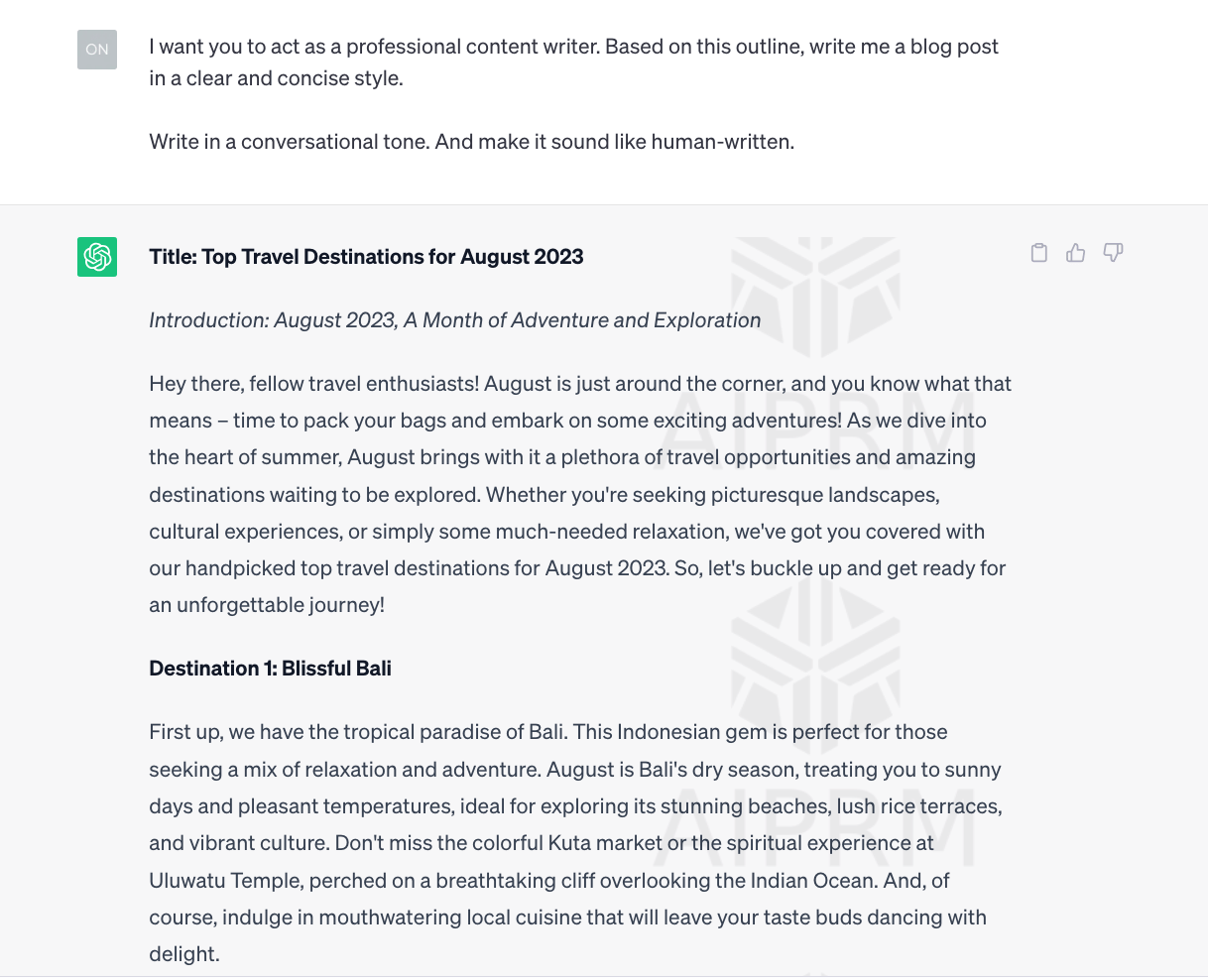
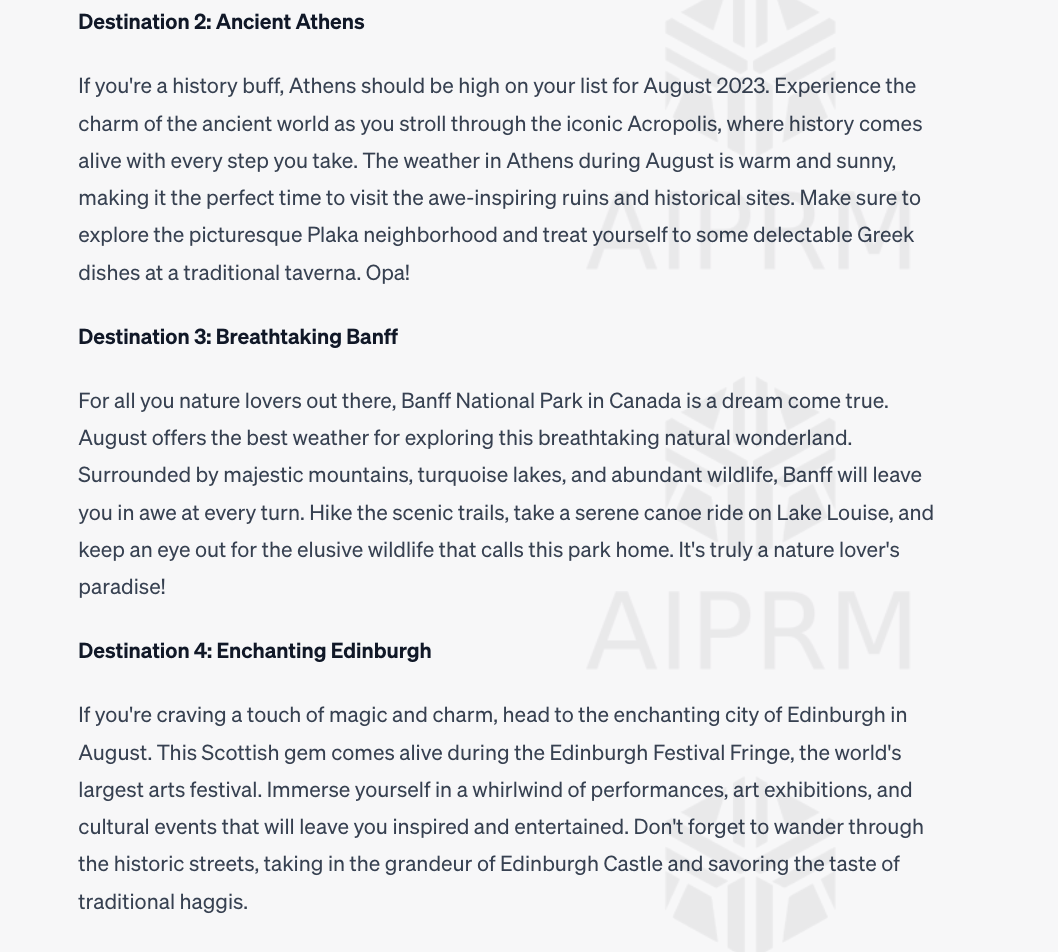

The more detailed the prompt, the better the result. For example, you can also specify who your target audience is and what kind of communication tone they like (professional or friendly?), how many words the content should be, or that the content should include a hook at the beginning.
To produce the kind of content you want, you need to train the AI correctly and enter the right prompts. This way, you will be able to produce better quality content.
Also, don't just think of it as blog content. You can repurpose this content by turning it into social media content, write a script for video content, or extend it even further and turn it into an e-book.
As you can see, content marketing is much faster and easier with AI tools!
5. Organizing Content
We came up with a content idea, created a calendar, outlined the content, produced the content and now it's time to edit it.
Editing content is as important as producing it, because this is the stage where we catch spelling mistakes, communication inconsistencies, and unnecessary word usage, which lets us produce much better quality content. Remember, thanks to a good editing process, your content can have exactly the quality you want.
At this stage, you can again benefit from artificial intelligence tools. You can make use of ChatGPT and Bard, but you can also take a look at Grammarly. Grammarly has become much more useful, especially with the AI Writer feature. We strongly recommend you to check it out.
Let's take a look at how you can edit your content with Google Bard. First of all, we intentionally added spelling mistakes in the introductory paragraph of the content we just prepared with ChatGPT. Let's see if Bard can detect them and give us a clean version.
We type the required prompt and here is the result:
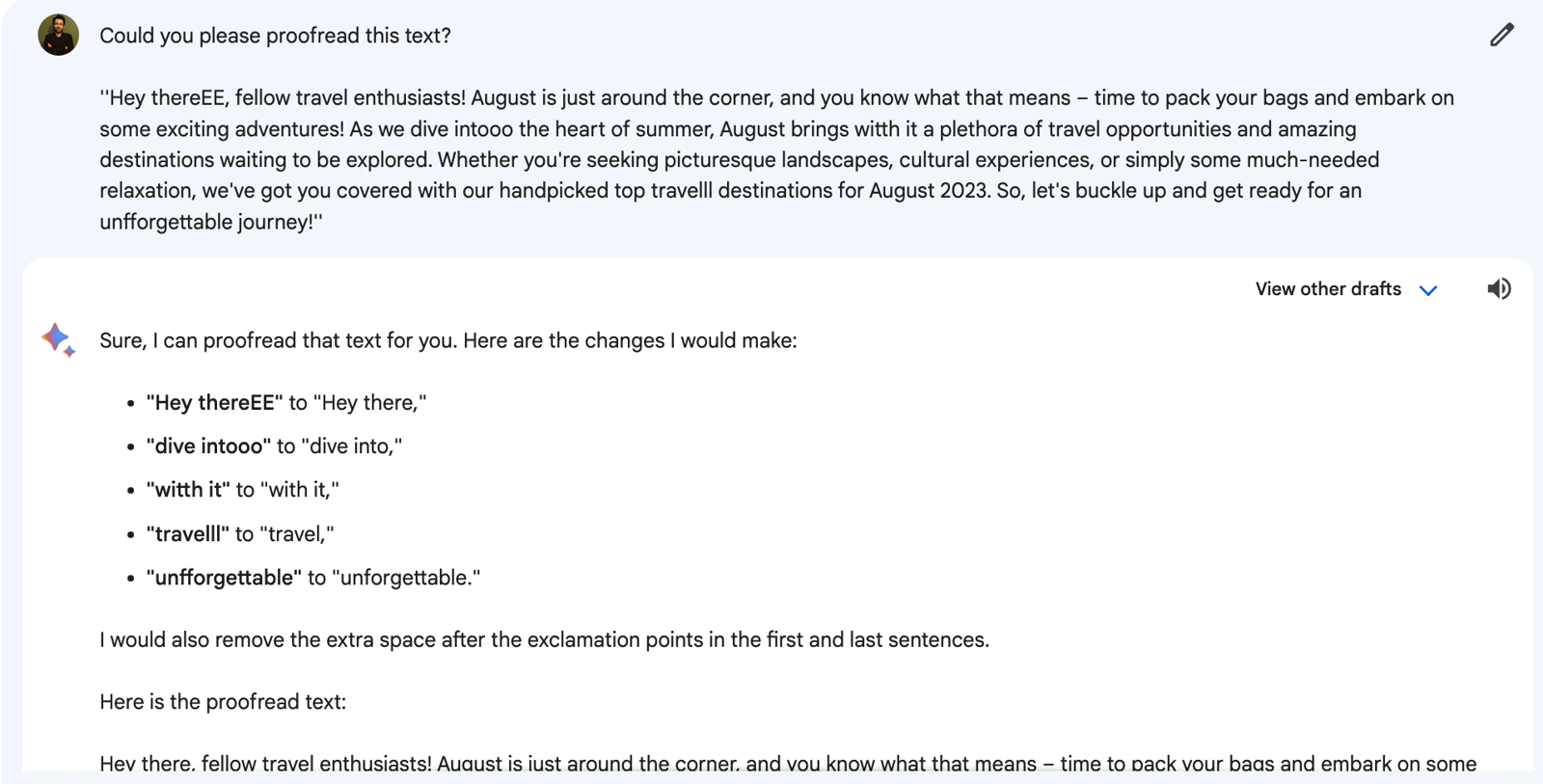
As you can see, not only did it give us an edited version of the text at the end, but it also told us which words we misspelled.
By using AI tools, you can quickly edit your content and get rid of annoying misspellings with ease.
Advantages of Artificial Intelligence in Content Marketing
We have provided important information on how to use AI effectively in content marketing, but what are the real advantages of AI at this point? Why should you conduct content marketing efforts with AI tools?
Here are the most prominent advantages:
- Writer's block is minimized.
- You gain speed and can manage your content marketing efforts much faster.
- You can produce more content in less time.
- You can use your time much more efficiently while producing and organizing your content.
- You can save money and put your budget to use in other places.
Last Words
Yes, we've come to the end of this content. With everything covered here, where you can find all the details you wonder about content marketing, we aimed to clear up every question mark in your mind. If you follow the advice in this content step by step, you'll be able to tap into the power of content marketing. In this way, you'll build brand awareness, strengthen your connection with your target audience, and increase your conversions.
If you want your brand to grow with content marketing and are looking for professional consultants, you're in the right place. Our consultants, experienced in content marketing, are ready to build the right strategy for you. We've served dozens of different brands in this field and delivered great success stories. Contact us now to succeed with content marketing!
Sources:
- http://contentmarketinginstitute.com/what-is-content-marketing/
- http://www.forbes.com/sites/joshsteimle/2014/09/19/what-is-content-marketing/#2c84b6e31d70
- http://contentmarketinginstitute.com/2014/05/essentials-getting-started-content-marketing/
- https://builtvisible.com/introduction-to-content-marketing/
- http://contentmarketinginstitute.com/2011/09/web-content-conversions/
- http://www.convinceandconvert.com/content-marketing/how-to-create-a-content-marketing-strategy/
- http://searchengineland.com/content-marketing-seo-bigger-picture-219796
- http://blog.hubspot.com/marketing/content-marketing-strategy-guide
- http://www.curata.com/blog/the-content-marketing-pyramid-how-to-generate-more-with-less/
- https://www.marketo.com/content-marketing/


