


There are many new and different techniques and approaches in the field of artificial intelligence. One of them is the "Few-Shot Prompting" technique, a highly effective, easy-to-implement way to get an AI model to generate a specific output.
What is Few-Shot Prompting?
Few-Shot prompting is a highly effective technique for prompting AI models to produce a specific output.
Few-Shot prompting works by supporting the model with input-output examples. It doesn't require a large amount of training data, and at the output of the prompt, the model gives the desired answers using the training it was given beforehand.
Few-Shot Prompting Examples
Let's look at the Few-Shot Prompting technique through a sentiment analysis example, and compare it with Zero-Shot Prompting outputs on that same example.
Let's ask the AI model to perform sentiment analysis for the sentence "The food is bad and the service should be improved" using the Zero-Shot Prompting technique (that is, without any example input-output).
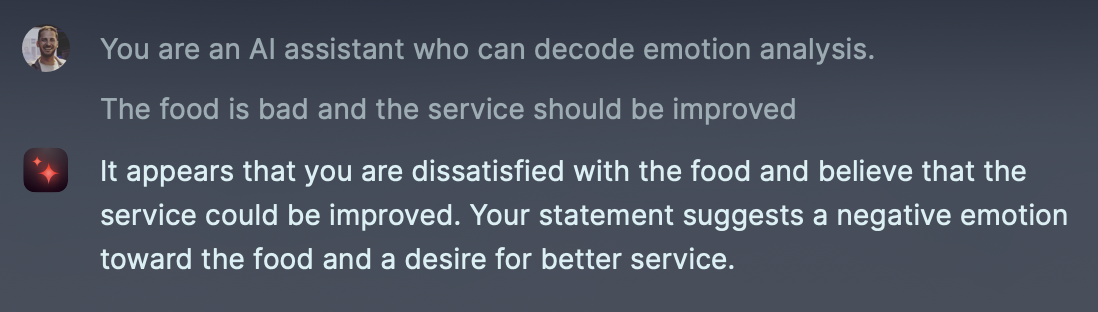
As you can see here, the AI analyzes the sentence and recognizes that it has a negative structure, but it doesn't hand us the 'negative' answer we want directly, it makes predictions instead.
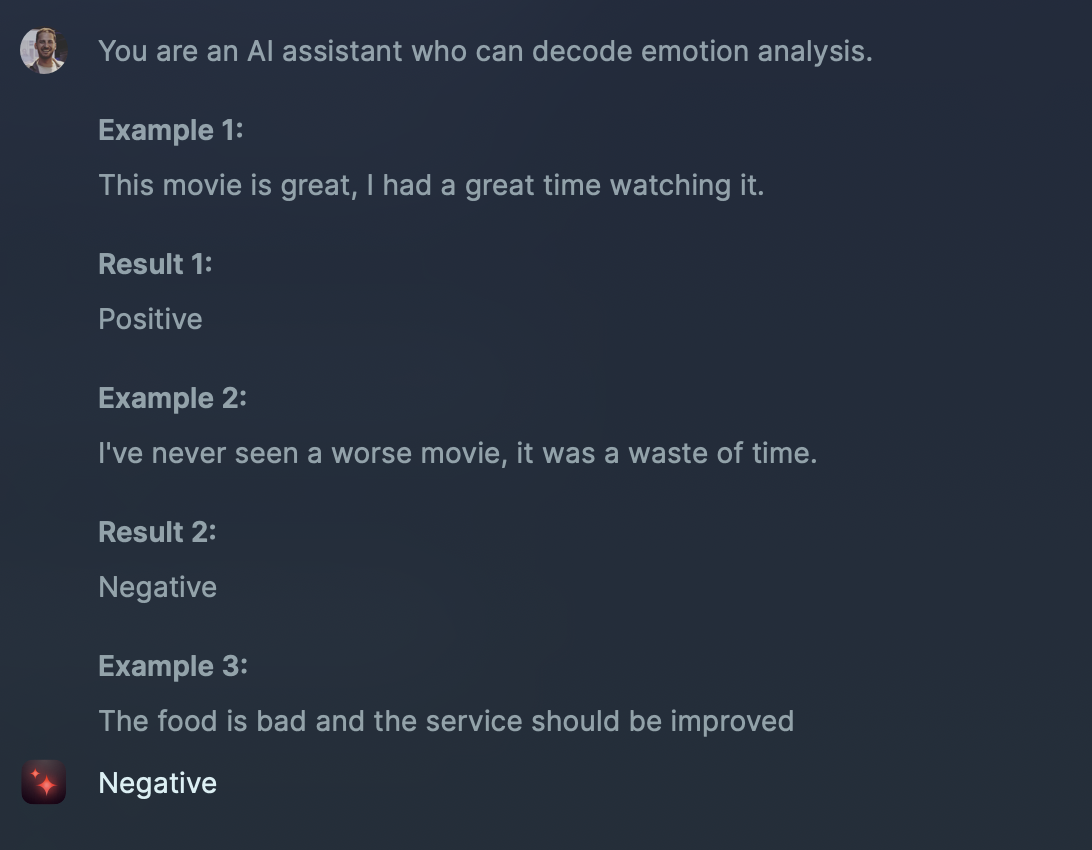
Now let's try this same task with the Few-Shot Prompting technique.
Let's give the model input and corresponding output examples, as follows.
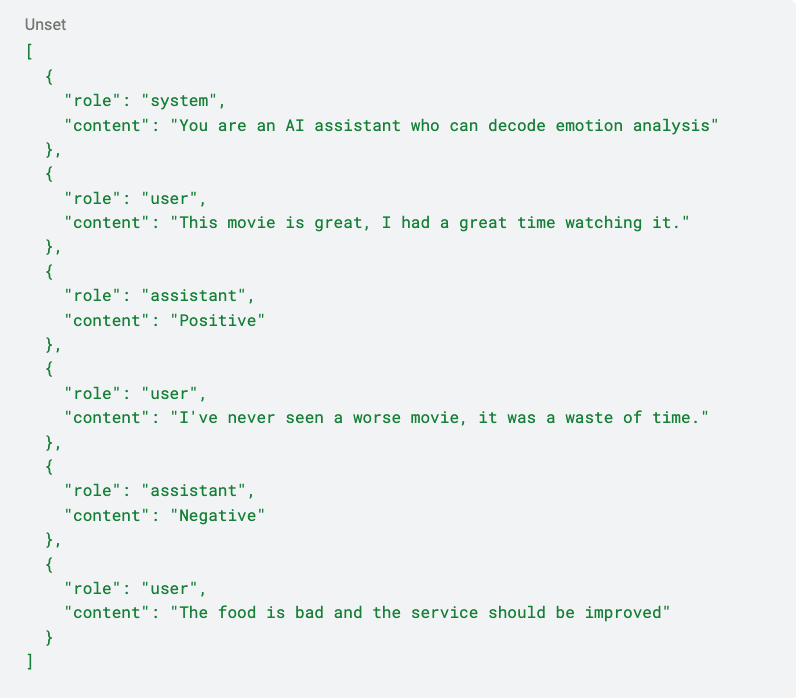
With the Few-Shot Prompting technique, the AI model analyzes the samples before giving the output. From that analysis, the model works out whether the output the user wants is 'positive' or 'negative'.
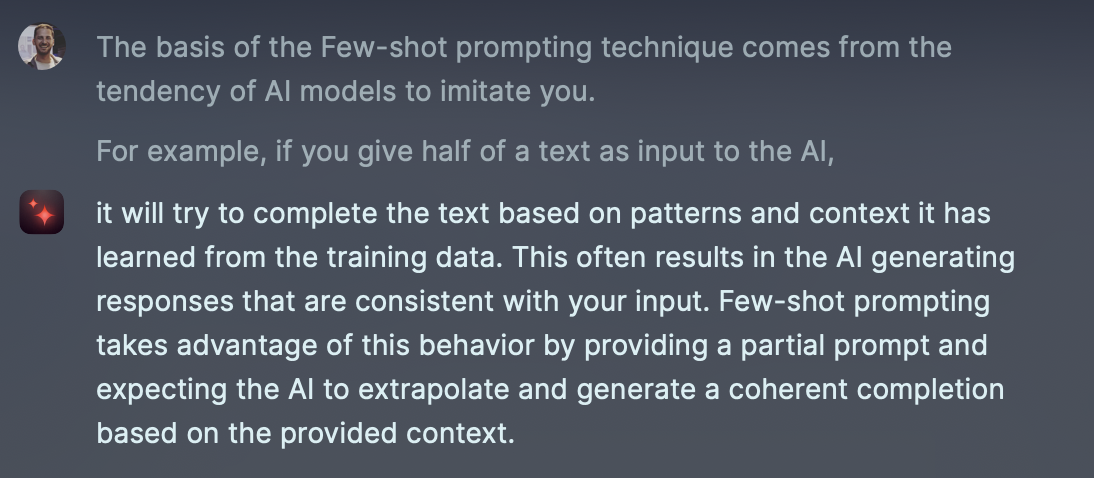
The Few-Shot Prompting technique rests on AI models' tendency to imitate patterns.
For example, if you give the AI half of a piece of text as input, it tends to continue that text by imitating you and predicting what comes next. In the same way, the Few-Shot Prompting technique gets the model to mimic the input-output examples you give it.
Few-Shot Prompting Limits
Although the Few-Shot Prompting technique can produce highly effective results, it may not be fully successful in specialized or complex problems.
For example, let's imagine that the AI model needs to solve advanced mathematical problems using the Few-Shot Prompting technique.
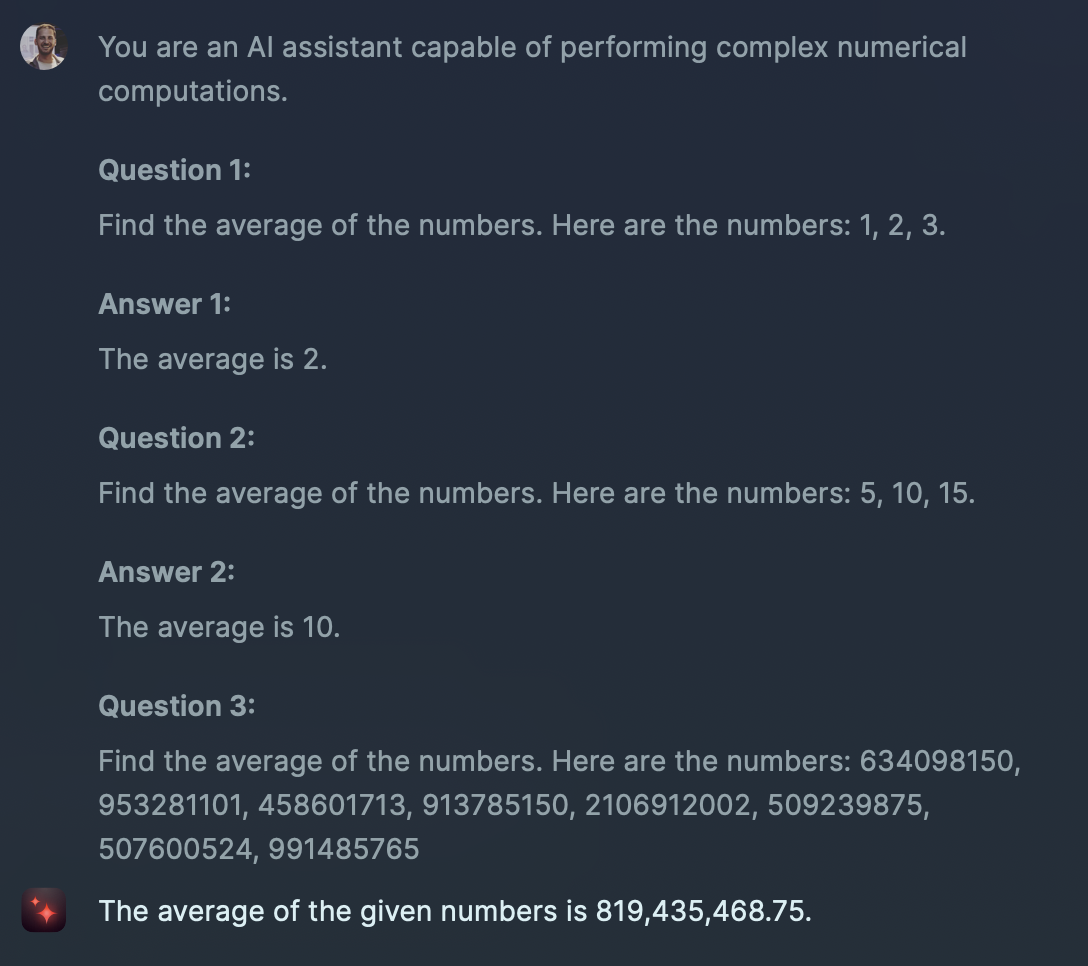
As the example shows, the model gives an erroneous result on a complex and complicated problem. The correct answer should be 884,375,535.
Note: I strongly recommend using the GPT-4 model for a problem this complex and complicated.
Tips for Few-Shot Prompting
Here are some tips to consider for improving your Few-Shot prompts:
Sample Output Availability
Making sure the outputs provided in the examples (such as 'positive' and 'negative' for sentiment analysis) are appropriate for your requests will increase the accuracy of the answer.
For example, if you train your model to solve math problems and the outputs in 5 examples are numerical and 1 of them is 'unsolved', this may make it harder for the model to provide the correct outputs.
Sample Consistency
Keep a consistent format across your examples. Giving examples in different formats will make it harder for the model to give the desired result directly in its answers.
For example, say you've built a Few-Shot prompt to solve mathematical problems:
- In the first example, you give '2 plus 2' as input and '4' as output,
- In the second example, suppose you give '3 plus 2' as input and 'This question is an addition operation and the answer is 5' as output.
Then, in the next question, when you want to get the answer directly as in the first example, the model may instead try to mimic the output pattern of the second question.
Task Description
Clearly stating what you want from the model before giving examples in your prompts will make it easier for you to get effective results.
For example, in your Few-Shot prompt for solving mathematical problems, giving the model the task "You are a math professor who can solve difficult problems" will increase the model's effectiveness in understanding the examples given and getting the output you want.
Example Variety
For the model to generalize its output better, it helps to increase the number of examples without taking them out of context.
For example, in your Few-Shot Prompt for solving mathematical problems, giving examples such as addition, subtraction, and square rooting, different but within the same context, can help you get more accurate outputs in complex questions.
Note: In the Few-Shot Prompting technique, increasing the number of examples too much for the problem can sometimes make the problem more complex. For this reason, I recommend keeping the number of examples at a normal level.
Otherwise, in a Few-Shot Prompting with 50 samples, the model may tend to generate a unique output rather than mimicking your output, and the likelihood of hallucinating increases.
In summary, Few-Shot Prompting is one of the most effective methods to get the output we want from AI models. By building our Few-Shot prompts from a good strategy framework, we can maximize the outputs we get from AI.


