


As of September 2025, Google limited its search results to 10 per page and disabled the long-used &num=100 parameter. That parameter let SEO tools pull 100 results in a single query, which enabled deeper SERP tracking. Now that it no longer works, tools have to crawl more pages to gather the same data.
This might look like a small technical detail at first glance, but SEO specialists noticed sudden data swings in their dashboards: impression counts in Google Search Console dropped sharply, while average ranking positions unexpectedly improved. One analysis found that 87.7% of sites saw a decrease in total impressions, and 77.6% saw a decrease in the number of unique keywords.
Why is the &num=100 Parameter Not Working?
Google never announced the removal of the &num=100 parameter in an official blog post, but in response to inquiries, it said this was "not an officially supported feature." Google had actually removed the "results per page" option from search settings back in 2018, yet the num=100 URL parameter kept working regardless. In September 2025, though, it suddenly stopped functioning entirely. According to Google's Danny Sullivan, the company disabled this function on purpose, to simplify the search experience and stop automated tools from abusing the system.
From a technical standpoint, a few plausible reasons stand behind this change:
- Reducing the scraping load: Queries for 100 results placed extra load on Google's servers.
- Aligning with the Mobile and Continuous Scroll Experience: Google adopted the infinite scroll model on mobile some time ago and is moving toward something similar on desktop. Users now see consecutive results by scrolling down the list instead of clicking through page numbers (though in the background, results still load in groups of 10). In this context, manually requesting 100 results through a URL no longer fits the new search experience.
- Improving data quality: Crawls run through this parameter were generating artificial impressions in Google Search Console (GSC). Once the parameter was disabled, the data lined up more closely with real user behavior.
Impacts on SEO Tools and Rank Tracking
Discontinuing the &num=100 parameter has directly affected SEO tools that gather data by crawling search results pages (SERPs).
- Less data: Tracking rankings beyond the first page has gotten harder. Tools can now offer more limited data, especially for results past the 2nd and 3rd pages.
- Crawl depth: Since it's no longer possible to pull 100 results on a single page, manual or automated crawling now needs up to 10 pages, which means burning through more resources.
- Keyword scope: The number of keywords tools can actually track has dropped, giving narrower visibility, especially for "long-tail" searches.
Impacts on Google Search Console and Reporting
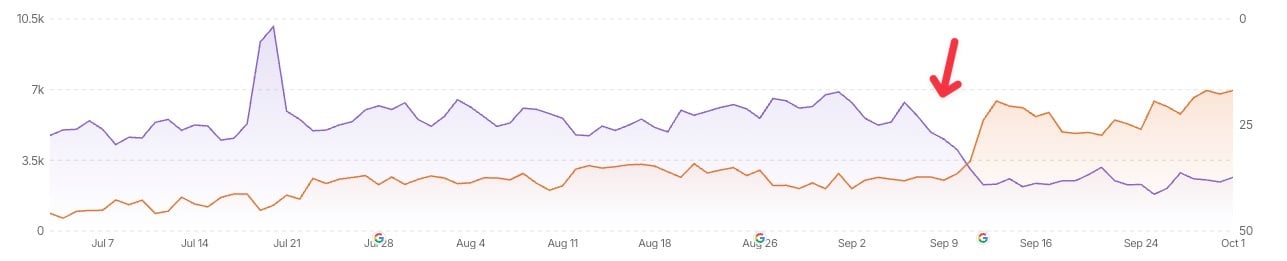
Removing &num=100 also had clear repercussions for the data inside Google's own tool, Google Search Console (GSC). In fact, the first wave of panic in the SEO community came from the dramatic changes many people saw in their Search Console charts.
- Drop in impressions: With bot-generated impressions removed, impression counts dropped sharply for many sites. That drop doesn't mean real users are actually seeing your site less, the main driver was simply filtering out bot-generated impressions. In other words, a page of yours sitting on page 5 of the results used to earn an "impression" anyway, thanks to SEO tools fetching pages with 100 results. Now, since Google only loads the first page of 10 results (plus the next 10 if a user actually clicks through to page two), your results beyond page 2 have mostly stopped receiving impressions at all.
Tired of reading?
You can also listen to this blog post as a podcast we created with Google NotebookLM on Spotify.
- Increase in average ranking: As impressions on pages 2 through 10 get reported less often, average rankings start to look mathematically better, but this isn't a real ranking improvement. Average position is the average of the ranking positions across every query where your site appears. Previously, even a site sitting at position 80 counted as an impression, and that large number of 80 pulled the average position calculation down with it. Now, since a position 80 result usually gets no impression at all, it's left out of the calculation entirely, and what remains is mostly high-ranking (low-numbered) positions like 5th or 12th. That arithmetically pulls the average up.
- Decrease in the number of keywords: Keywords ranking on page 3 and beyond now get reported less often, while first-page and Top 20 results stand out more.
- Difficulty in comparing with the past: Drawing direct comparisons between the post-September 2025 period and 2024-2025 can be misleading. It's worth having SEO teams add a note in their reports for this date, flagging that "metrics may be skewed due to a change in Google's data collection method as of September 2025."
To sum up these effects, expect to see the following changes in your Google Search Console performance reports after September 2025:
- Impressions: A significant drop in desktop searches starting around September 10-12, 2025. This is an artificial drop caused by bot-generated impressions dropping out of the report (mobile impact may be more limited, since &num=100 wasn't in play there due to continuous scroll).
- Average position: A sudden "improvement" (a numerical decrease in the average position value). Since less low-ranking (20+ position) data gets included, your average position will appear to improve, but that's simply a mathematical result of the metric change.
- Organic clicks: No change. Since clicks from real human users continue as usual, your total organic traffic graph won't be affected during this period.
- Click-Through Rate (CTR): As impressions decrease while clicks stay the same, you may see an increase in CTR percentages. That's also just a result of the data rebalancing.
How to Create a Reporting Strategy
In short, Google removing the &num=100 parameter is pushing SEO teams to update how they report and evaluate performance.
- Metrics: Surface-level indicators like impressions and total keywords have become less reliable since this change. Reports can lean more heavily on metrics that reflect real results, like clicks, sessions, conversions, and revenue.
- Historical Comparisons: Since bot-generated impressions distorted the data during 2024-2025, direct comparisons with the new period can mislead. Highlighting the differences between periods, rather than running a straight trend analysis, will produce healthier results.
- Cross-Tool Data Comparison: When Search Console data gets confusing, it can be worth supplementing it with organic traffic and conversion data from the Analytics side.
Resources:
- https://searchengineland.com/google-num100-impact-data-462231
- https://searchengineland.com/google-search-confirms-it-does-not-support-the-results-per-page-parameter-462244
- https://www.webpronews.com/google-ends-num100-search-parameter-impacting-seo-tools/
- https://www.interodigital.com/blog/google-quietly-killed-the-num100-parameter-heres-why-your-rankings-and-impressions-just-got-weird/
- https://www.seroundtable.com/google-search-drops-100-results-parameter-40097.html
- https://locomotive.agency/blog/google-removes-num100-parameter-what-this-means-for-your-website/
- https://ahrefs.com/blog/google-serp-changes-update/


