


SEO & Conversion Copywriting
Product & Service Copywriting
Give buyers enough specific information to judge whether the product or service fits their needs.
Product & Service Copywriting explains what an offer does, who it serves, and where its scope ends. The copy helps suitable buyers recognize the fit and gives others enough clarity to move on without a sales call. You walk away with approved specifications and comparisons, copy organised for reuse across surfaces, and a named owner for keeping it current.

Some of the 500+ brands we've worked with
Selected brands we’ve worked with across industries.


On this page
How we run it
How the copy gets grounded in fact
Each step keeps persuasive language tied to a specification someone has verified.
Get the facts straight first
Before any persuasive language happens, we confirm the actual specifications, service scope, and limits with whoever owns the product. The last version of the deck is usually out of date. The product or service owner signs off on the fact sheet before any persuasive language gets written.
A verified fact sheet with product or service owner sign-off.

Find the real use cases
We look at actual support questions and customer conversations to find the use cases people genuinely have. Each use case must trace to a real support ticket or sales call. A strategist verifies that link.
A set of validated use cases pulled from real buyer questions.

Connect features to what they're actually for
Every feature or service line gets tied to the concrete problem it solves for a specific kind of buyer. A benefit that could describe any competitor is doing no work. A strategist decides which use cases are important enough to include in the matrix rather than leaving that judgment to the drafting agent.
A benefit-proof matrix linking each feature to its use case and evidence.

Write it modularly, so it's reusable
Copy gets built in reusable blocks, headline, spec line, use case, proof, so product and marketing teams can recombine it across pages without starting over each time. An editor checks that each reusable block still matches its verified fact after being recombined across pages.
A modular copy library organized by feature and use case.

Set up how it stays current
Products change. We agree who owns updates when a spec shifts, and build that into a simple workflow. The named owner agrees to review the copy again the next time the product changes.
An update workflow with a named owner for keeping the copy current.



The product owner checks what we claim it does
Approved specifications give agents a safe base for producing modular variations across similar SKUs or service tiers. The fact sheet still belongs to the product owner, who checks it against the current offer before persuasive copy begins. Competitor comparisons get the same scrutiny. An omitted comparison is less damaging than a confident claim that turns out to be wrong.
What you get
The modular copy library
You receive a reusable copy library, backed by an approved fact sheet and a workflow for keeping the language current.
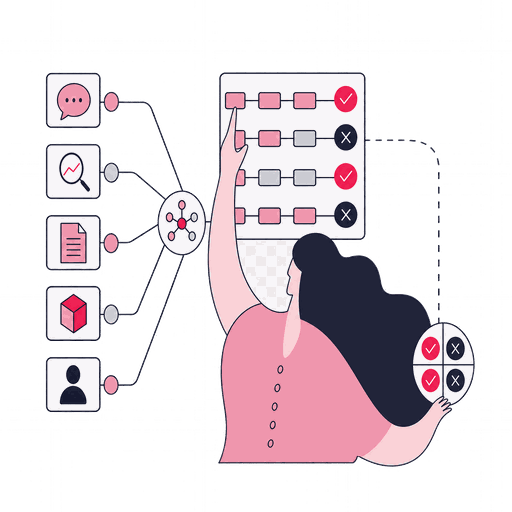
Verified fact sheet
The specifications and service boundaries, confirmed by whoever owns the product.
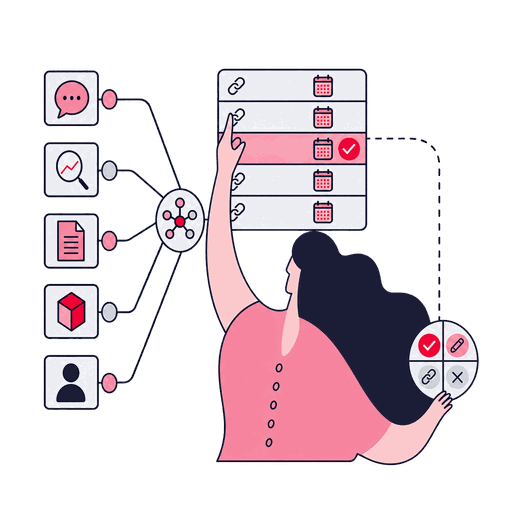
Benefit-proof matrix
Each feature or service line tied to a real use case and the evidence behind it.

Modular copy library
Reusable blocks, headlines, spec lines, use cases, proof, built to recombine across product and service pages.

Update workflow
A named process for keeping the copy current when the product or service changes.


We call it done when: the product or service owner has approved every specification and comparison, the copy is organized for reuse, and there's a named owner for keeping it current.
Who it fits
When people need to know what this actually does
The scope is one specific product or service, explained clearly enough for buyers to evaluate fit. Brand storytelling and full-site copy require different methods.
A good fit when
- Buyers are comparing your offer with alternatives, but the current copy does not give them clear specifications or service boundaries.
- Product documentation and support questions contain the facts buyers ask about, yet those facts have not become copy the product owner can approve.

Better handled as other work when
- The copy is expected to make the offer sound stronger than the verified fact sheet allows, so the claim would say more than the product owner has confirmed.
- A competitor comparison has to appear even though nobody can show the evidence or scope that would let a buyer verify it.
- The product is complicated, but the plan relies on generic benefit copy instead of explaining its use cases, limits, specifications, and the proof behind them.
People who write and ship this content
Some of these consultants write the pages themselves. Others plan distribution or check how a piece performs once it's live, so the team below covers more than one stage of the work.

Metehan Urhan
New Business & Partnership Manager

Ezgi Gülsen Yaylı
SEO Manager

Hande Parmaksız
SEO Manager

Sinem Bakır Yavaş
Senior SEO Executive

Elif Naz Akan Karakoç
Senior SEO Executive

Sena Önder
Senior SEO Executive

Deniz İmre Temiztürk
Content Specialist

Bensu Tınastepe
Senior SEO Analyst

Gülşah Şahin Özkan
Senior SEO Analyst

Ali Özgün Öz
SEO Executive

Ruhan Tiryaki
Senior SEO Analyst

Emir Kağan Kahveci
SEO Analyst

Mehmet Aktuğ
Co-Founder & COO
Tools we use
Tools behind this work
 Grammarly
catches a spec or feature name written a different way on a second SKU page
 Airtable
the row-per-SKU fact base that answers the FAQ about out-of-date internal docs
 Klue
Kluekeeps a competitor comparison's claims current after the page ships, not just accurate on launch day
 Notion
the modular blocks that get reused across pages instead of rewritten each time
Where this leads next
Methods connected to Product & Service Copywriting

Upstream
Landing Page Copywriting
Often where this copy first gets tested, once a specific campaign needs to explain the offer fast.

Downstream
Email Copywriting
A natural next step for putting the same verified facts in front of an existing list.

Complementary
Executive Ghostwriting
This page explains what you sell, and an executive's own words in a ghostwritten piece can explain why the team decided to build it this way.


Start the work
Need clearer product or service copy?

Before we start