


Zeo delivery method
Link Reclamation & Broken Link Recovery
Repair the destination you own first, ask a publisher only when the correction helps their reader, and fix the process behind a loss that keeps repeating.
A lost link isn't always recoverable, and a working replacement on your own site isn't automatically the right one to point a publisher at. We fix what we control first, the destination itself, and only contact a publisher when the correction genuinely improves their reader's path, not because it would be convenient for us. You restore valid destinations and pursue deserved references without pressuring publishers or rerouting old citations to convenient money pages.

Some of the 500+ brands we've worked with
Selected brands we’ve worked with across industries.





































 MeteksanGlobalCase Study












On this page
Stages and gates
How we do it
Recovery begins on your own site. Contacting a publisher before repairing the destination puts the work in the wrong order.
Confirm what was genuinely lost
We combine dated backlink exports with live checks of source pages and destinations to separate real losses from duplicates, tool noise, and intentional removals. The flagged losses get verified by our link analyst before any of them reach the inventory.
A recoverable-link inventory with defined scope, exclusions, source context, and an owner for each candidate.

Fix the destination you control
We test old and proposed targets for status, canonical behavior, redirect hops, content equivalence, user usefulness, and ongoing ownership. A person judges whether the proposed target actually satisfies the original reader's reason for linking.
A redirect, content repair, retain, or no-action decision based on the original reference, not convenience.

Decide whether publisher contact adds value
We compare the source context with the replacement, then choose an owned repair, unlinked-mention request, publisher correction, or no contact. The outreach lead weighs whether contacting the publisher would help their reader or just chase a link, and answers accordingly.
A focused correction queue with evidence, uncertainty, an owner, and a clear reason for leaving some references alone.

Make the correction simple to accept or ignore
A person sends a concise, source-specific note that identifies the broken reference, offers the relevant replacement, and makes opting out straightforward. Every note is read for accuracy and tone by the outreach lead, who can decide it should not go out at all.
A respectful correction record with limited follow-up and no commercial pitch disguised as maintenance.

Confirm the outcome and prevent another loss
We recheck live destinations and references, record complaints and corrections, and group recurring causes by redirect, content, or ownership failure. Which recurring cause earns a process fix, and which gets one more repair, is our technical lead's call.
A recovery ledger plus a preventive fix for patterns that would otherwise keep breaking references.



AI reconciles the exports and drafts the note; a person decides whether it is worth sending.
AI deduplicates overlapping backlink exports and flags losses that may be tool noise, runs the status, canonical, and redirect-hop checks across every candidate destination at once, compares source-page context with the replacement and ranks candidates by how closely the destination still matches the original reference, drafts an initial note describing the exact broken reference and proposed replacement, and groups recurring causes by redirect pattern, content change, or ownership gap. It sends nothing. We do not pressure publishers, disguise promotion as an error report, ignore opt-outs, or request a link that offers readers no benefit, we do not redirect an unrelated expired URL to a money page because it has historical links, and we do not claim control over an editorial mention.
Deliverables and acceptance
What you get
The deliverables separate repairs you own from changes an independent publisher may choose to make.
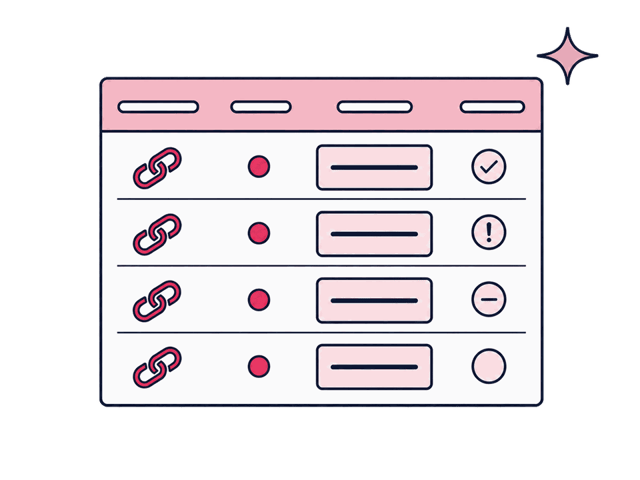
Link ledger
Recoverable-link inventory
Redirect map
Destination & redirect decisions
Prioritized backlog
Personalized correction queue
Audit report
Recovery validation ledger


We call it done when: The inventory, destination decisions, correction queue, and recovery ledger are done when every loss is reconciled to a dated source URL, historical target, link context, current state, and owner rather than a tool duplicate, every proposed target has passed live status, canonical, hop, relevance, and maintenance checks against the original reference, every queued item names its sender, follow-up limit, opt-out state, and reason to proceed at all, and the ledger records repaired destinations, restored references, complaints, unresolved cases, recurring causes, and the next owned decision.
Fit and readiness
When you need this
This method fits genuine lost references, but every recovery action still requires page-level judgment.
A good fit when
- Historical backlink data identifies valuable references to URLs that now return errors, redirect poorly, or no longer represent the original resource.
- You have verified unlinked brand mentions where the right destination would make the source more useful to its readers.
- You want to correct repeated destination failures at their source instead of repeating the same recovery campaign every quarter.

Better handled as other work when
- You want to contact unrelated sites in bulk or pressure editors to change links they chose independently.
- The proposed replacement does not satisfy the original reference, or the plan sends every expired URL to a commercial category.
If one of these is closer to your situation, start here instead: Link Building & Off-Page SEO
We call it done when: The destination you own works, every correction request has an accurate reason and a useful target, and repeated link loss forces a change to the redirect or content process behind it.
The specialists behind this SEO work
Zeo's SEO work goes back to 2006, when we started what we call the first SEO blog in the MENA region. The consultants shown here are doing that work today, matched to what this page covers.

Yiğit Konur
Founder & Chief Strategy Officer

Hande Parmaksız
SEO Manager

Sena Önder
Senior SEO Executive

Sinem Bakır Yavaş
Senior SEO Executive

Metehan Urhan
New Business & Partnership Manager

Bensu Tınastepe
Senior SEO Analyst

Gülşah Şahin Özkan
Senior SEO Analyst

Ali Özgün Öz
SEO Executive

Ruhan Tiryaki
Senior SEO Analyst

Aybüke Göktuna
Senior SEO Analyst

Yağmur Bayram
Sr. SEO Analyst

Emir Kağan Kahveci
SEO Analyst

Zafer Yıldız
Web Analytics Manager

Deniz İmre Temiztürk
Content Specialist

Ataberk Yüzat
SEO Executive
Tools we use
Tools behind this work
 Ahrefs
rebuilds dated backlink history for lost and broken references
 Screaming Frog
tests old targets, replacement pages, canonicals, and redirect hops
 Majestic
cross-checks historical references and source context from another index
 Linkody
watches repaired references for later loss or destination changes
 LinkChecker.pro
rechecks source pages and destinations after each recovery action
 BuzzStream
records source-specific correction requests and strict follow-up limits
Where this fits
Related services

Link Building & Off-Page SEO
Authority & Link Building
Reclaiming dead external backlinks restores existing historical authority, providing an efficient complement to net-new link prospecting.
SEO Audit
Backlink & Authority Audit
Audit crawl data exports broken target URLs, supplying the prioritized list of referring domains requiring 301 redirect rules.

Technical SEO
Crawl & Index Optimization
Redirecting broken backlink target URLs eliminates dead-end crawl traps, improving overall search engine crawl efficiency.


Next step
Begin with references you may already deserve

Before we start