


Experiment Learning Repository
An experiment has little lasting value if nobody can find its record.
We rebuild every reconstructable past experiment as a standard record covering its hypothesis, mechanism, evidence, result, and decision. Tags show what the test examined and who saw it. When two records point in opposite directions, a reviewer sees the conflict before the next hypothesis reaches approval. Your team can retrieve the evidence and decision behind a past experiment before the same dead hypothesis consumes another testing slot. This fits a testing program with enough history that memory, old decks, and former employees' folders can no longer carry the record.

Some of the 500+ brands we've worked with
Selected brands we’ve worked with across industries.





 GeneraliGlobalCase Study















 OdeabankGlobalCase Study









































 Albaraka TürkGlobalCase Study
























On this page
How the work runs
File the result so the next team can find it
Before a hypothesis moves forward, the proposer searches by mechanism and audience. Reviewers then compare the evidence behind any conflicting records. AI can suggest tags and surface possible matches, but a person decides whether two past results really contradict each other.
How we hold ourselves to it
- Wins, nulls, negatives, and invalid results share one record format
- Every new hypothesis goes through an archive search before approval
- Reviewers add a resolution note when past results conflict
- Search follows mechanism and audience
Inventory what's already run
Collect every past experiment that can still be reconstructed, including its hypothesis, design, result, and decision, even when it was not documented properly at the time. The research owner confirms the inventory before archiving begins.
Inventory of every past experiment that can still be reconstructed, with its hypothesis, design, result and decision.
Standardize the record format
Rebuild each past experiment into the same structure: hypothesis, mechanism, evidence, result, confidence, decision, so a test from three years ago reads the same way as one from last week. The CRO strategist confirms a standardized record accurately represents what actually happened.
Rebuilt archive where every record uses the same hypothesis, mechanism, evidence, result, confidence and decision fields.
Tag by mechanism and audience
Tag each record by the mechanism it tested, such as urgency, trust, clarity, or friction, and by the audience it ran on. A new hypothesis about urgency can then surface every past urgency test across the archive. The research owner approves the tags before the record is searchable.
Mechanism and audience tag index across the whole archive.
Surface contradictions across the archive
Cross-check records with similar tags and opposite directional results. Each possible contradiction goes to a reviewer for a resolution note. The CRO strategist reviews flagged contradictions and adds a resolution note.
Contradiction log pairing similar-tag records with opposite directional results, each routed to a reviewer.
Build the reuse-check step into new hypothesis approval
Require every new candidate hypothesis to be checked against the archive before roadmap approval. The search catches dead or contradicted ideas before they consume another testing slot. The CRO strategist reviews the surfaced history and decides whether the new hypothesis still stands.
Approval gate requiring a completed archive search before a hypothesis reaches the roadmap.
Keep the archive current
Add every newly completed experiment to the repository in the same standard, tagged format. The archive stays current as the program keeps testing. The research owner approves each new entry before it's added.
Standing intake that adds each completed experiment to the archive in the same tagged format.


What lands with your team
The records people need to search and compare
The archive has to help during approval. These linked records let proposers find old evidence and give reviewers enough context to understand conflicts before another test is approved.
Standardized experiment archive
Every reconstructable past experiment in one consistent format: hypothesis, mechanism, evidence, result, decision.

Mechanism and audience tag index
The index lets someone search by the mechanism tested and the audience that saw it.

Contradiction log
Cases where two past tests reached opposite conclusions on a similar mechanism, with a resolution note where one exists.

Reuse-check record
The log of new hypotheses checked against the archive before approval, including any revised or rejected after the search.


Before the work starts
When this work is the right next step
When the first result cannot be found, the same hypothesis gets tested again. A year after a test runs, its record is often a slide in a deck nobody can find, inside a folder named after someone who left the company. The idea returns as a new proposal. Sometimes it produces the same null result. Sometimes it conflicts with the old test because the first record's data-quality problem was forgotten.
A good fit when
- Your experiment history now spans more records than anyone can remember, so past evidence disappears into old decks when a new idea arrives.
- New hypotheses keep repeating tests from a year or two ago, but the proposer cannot retrieve the earlier mechanism, audience, and result.
- Several teams contribute experiments, yet no searchable archive lets reviewers compare nulls, negatives, wins, and conflicting results before approval.
- A "new" hypothesis turns out to be a test that already ran and came back null.
- The evidence behind last year's "win" is missing.
- Two tests reached opposite conclusions about the same page element, and nobody connected them.
- Wins get shared. Null and negative results fade from memory.

Better handled as other work when
- Only one or two experiments have finished, so a standardized archive would contain too little history to change a new hypothesis decision.
- The team skips the repository, so archived evidence cannot stop the same hypothesis from consuming another test slot.
- Past decks and tickets lack enough evidence to reconstruct the hypothesis, implementation, or result, so the archive would preserve guesses.
People who own a single channel
Paid Search, Paid Social, CRO, and Programmatic each run under a named owner at Zeo. The consultants below are matched to the channel this page is about, so you can see who you'd actually work with.

Serap Yurtvermez
Performance Marketing Team Lead

Abdullah Tanıdır
Performance Marketing Team Lead

Sevda Yurtvermez
Performance Marketing Team Lead

İlker Emir
Senior Performance Marketing Executive

Onur Durdağı
Performance Marketing Executive

İpek Ezer
Performance Marketing Executive

Burak Pehlivan
Co-founder & CEO
Tools we use
Tools behind this work
 VWO
VWOthe one place old test insights go instead of a doc nobody can find eight months later
Related work

Parent service
CRO & Experimentation
This archive earns its keep only when a new hypothesis is checked against it before approval, and that approval step sits with CRO's research and experiment-contract work.
Checks against this archive
Experiment Hypothesis Roadmap
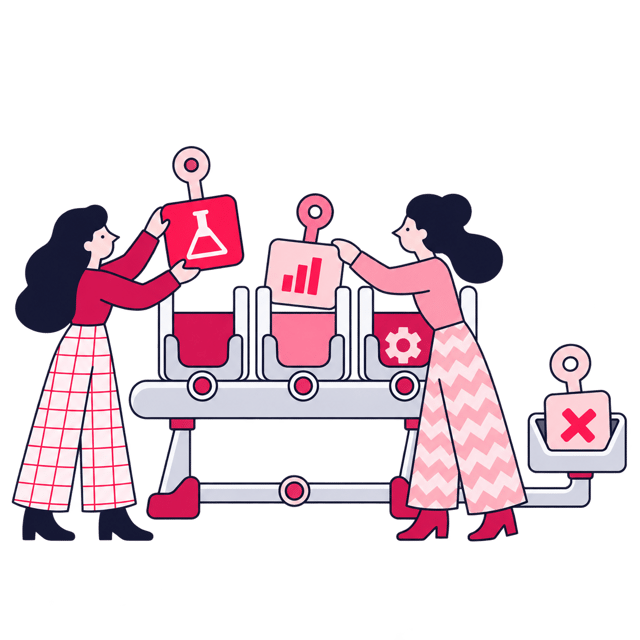
The method that scores new hypotheses and is required to check them against this repository before they're approved.

Feeds this archive
A/B Test Design & Analysis
The method that produces the completed experiment record this repository archives once a test concludes.


Make the next hypothesis search the past first
Give old test records somewhere useful to live
