


Zeo delivery method
Opportunity & Data Modeling
Evidence that the page set deserves to exist before anyone builds a template: verified demand, fields with owned sources, and the experiment that would overturn the call.
A search pattern can repeat across thousands of URLs even when the underlying case for a page doesn't, so before any template gets built we check that the demand is genuine and the data behind it is dependable. We verify the demand pattern against real evidence, map exactly where the source data runs thin, and stress-test the proposed page set until we're confident it deserves to be indexed. Before you invest in templates, you get evidence that the proposed page set has verified demand, dependable data, and a defensible reason to be indexed.

Some of the 500+ brands we've worked with
Selected brands we’ve worked with across industries.
























 MeteksanGlobalCase Study





 VisperaGlobalCase Study














On this page
Stages and gates
How we do it
The four stages are designed to expose a weak idea before it becomes an expensive build.
Verify the demand pattern
We pull representative queries across markets, devices, and the long tail, then review the pages ranking for them. Search volume alone has misled plenty of people. Before anything gets modeled on it, our research lead says whether that ranking pattern is durable demand or a temporary SERP quirk.
A clear read on which query patterns hold up and which fall apart the moment you look closely.

Map the data's limits
We trace every entity and attribute back to a real, owned source, and flag what's missing, duplicated, or too thin to build on. The data owner separates the flagged fields that enrichment can fix from the ones that disqualify a record outright.
An entity map that says exactly which fields are trustworthy enough to publish and which aren't.

Set record eligibility
We combine validated demand with the available data to assign every record one of four states: pass, hold, enrich, or reject. We do not assume every row deserves a URL. The eligibility threshold is set by a person, who then has to be willing to defend the page-set estimate that falls out of it.
A page-set estimate you can defend, with a reason attached to every record that didn't make the cut.

Stress-test it before you believe it
We run the model against your best records and your worst ones on purpose, looking for false positives and thin pages hiding in the good news. Proceed, narrow, or stop is decided by the data owner, who also names the single observation that would change their mind.
A proceed, narrow, or stop decision, plus the exact observation that would change our mind.



AI clusters, traces, and scores at volume; a person sets the threshold and defends it.
AI pulls and clusters representative queries across markets, devices, and the long tail at a scale no analyst would attempt by hand, traces every entity and attribute back through the source systems and flags what is missing, duplicated, or too thin to build on, scores every record against the combined demand and data rules in one pass, and runs the model against a deliberately hostile sample to surface the false positives a strong score hides. The threshold is a person's call. We do not fill a missing field with generated text to make a thin record look complete, a page-set estimate is a decision model rather than a traffic guarantee, and we do not scrape personal or restricted data to pad an entity dataset.
Deliverables and acceptance
What you get
Concrete things you can act on. Potential is easy to present and hard to spend.

Brief
Opportunity model
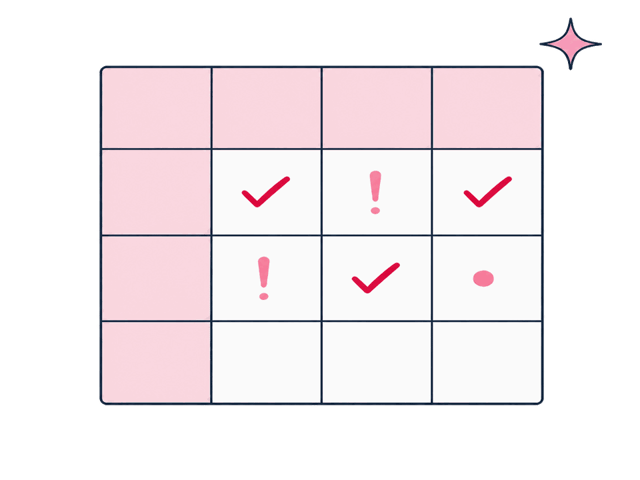
Decision matrix
Entity-field contract

Evaluation sheet
Eligible page-set estimate

Tracking plan
Assumption & stop-rule register


We call it done when: The opportunity model, entity-field contract, page-set estimate, and assumption register are done when the model states the audience, the recurring decision, and the evidence with counterexamples still visible, every field is tied to an owned source, an owner, and a freshness rule, every record carries a pass, hold, enrich, or reject state with its reason attached, and the register lists what is still assumed, what would prove it wrong, and who owns the next experiment.
Fit and readiness
When you need this
This method tests the demand pattern and its underlying data before programmatic production begins.
A good fit when
- You see a query pattern across hundreds or thousands of entities, but have not yet shown that the data can support pages that are both useful and distinct.
- You need a clear proceed, narrow, or stop decision before assigning engineering time to templates.
- You want to find gaps, duplicates, and thin coverage in the data before they appear on live pages.

Better handled as other work when
- This is not the right process if the page-count target is fixed regardless of what demand and source data support.
- We cannot model the opportunity when the data does not trace back to a maintained, accountable source.
If one of these is closer to your situation, start here instead: Programmatic SEO
We call it done when: Each record carries a clear page decision. Publishable, needs enrichment, or ineligible. It also identifies the experiment that could overturn that decision.
The specialists behind this SEO work
Zeo's SEO work goes back to 2006, when we started what we call the first SEO blog in the MENA region. The consultants shown here are doing that work today, matched to what this page covers.

Samet Özsüleyman
SEO Manager

Yiğit Konur
Founder & Chief Strategy Officer

Hande Parmaksız
SEO Manager

Sena Önder
Senior SEO Executive

Ali Özgün Öz
SEO Executive

Bensu Tınastepe
Senior SEO Analyst

Gülşah Şahin Özkan
Senior SEO Analyst

Ruhan Tiryaki
Senior SEO Analyst

Yağmur Bayram
Sr. SEO Analyst

İlker Emir
Senior Performance Marketing Executive

İpek Ezer
Performance Marketing Executive

Onur Durdağı
Performance Marketing Executive

Sevda Yurtvermez
Performance Marketing Team Lead

Serap Yurtvermez
Performance Marketing Team Lead

Abdullah Tanıdır
Performance Marketing Team Lead
Tools we use
Tools behind this work
 Semrush
profiles ranking pages across representative query and market samples
 Ahrefs
finds long-tail variants and the pages already serving them
 Google Keyword Planner
checks whether proposed entity patterns carry measurable search demand
 Google Trends
separates durable demand from seasonal or temporary query spikes
 Keyword Cupid
clusters query samples before records receive page eligibility states
 Google Search Console
tests modeled demand against queries the existing site already earns
Where this fits
Related services

Programmatic SEO
Page Templates & Content Models
Data modeling defines the programmatic attribute schemas and content entities that render across automated page templates.

Programmatic SEO
Generation & Publishing Pipelines
Structured data entity models feed generation pipelines to publish database-backed programmatic landing pages at enterprise scale.

Programmatic SEO
Quality Control & Index Management
Data model validation rules enforce completeness criteria, ensuring sparse database records are excluded from indexable page generation.


Next step
Find out whether the data supports a page set

Before we start