


Zeo delivery method
SEO Governance & Operating Models
One accountable owner per recurring decision, evidence teams know they must bring, exceptions that expire, and finished work that changes the next rule.
SEO work rarely stalls because nobody knows the recommendation, it stalls because the evidence, the authority to approve it, and the capacity to ship it belong to different teams, and nobody can say who actually decides. We trace how decisions get made today, assign each recurring decision a clear source of authority, and pilot the new process on one live stream of work before judging it by anything other than finished work. We turn recurring SEO decisions into a working system with one accountable owner, clear evidence, usable exceptions, and closure that returns learning to the next request.

Some of the 500+ brands we've worked with
Selected brands we’ve worked with across industries.









 GeneraliGlobalCase Study















 Albaraka TürkGlobalCase Study













































 OdeabankGlobalCase Study
















On this page
Stages and gates
How we do it
We start from the decisions teams make today and the places where work sits waiting. Ideal organization charts are easy to draw and hard to live in.
Trace the decisions as they happen today
We follow recurring work such as template releases, redirects, content claims, index exceptions, and market launches from request to outcome. A person confirms which waiting states are genuine bottlenecks and which are normal review time.
A decision inventory showing triggers, evidence, recommenders, approvers, implementers, waiting states, and escalation gaps.

Give each decision a clear source of authority
We define who is responsible, accountable, consulted, and informed, then document capacity, service expectations, urgent routes, and the right to appeal. The accountable leader and affected teams agree who truly holds decision authority and who will commit the required capacity.
You receive a decision matrix with one accountable role for each decision and no circular approval process disguised as consensus.

Turn repeated judgment into usable standards
We write intake, evidence, review, implementation, and closure rules with examples, prohibited shortcuts, and time-limited exceptions. The accountable role checks that the written rule matches how they actually want to decide.
A standards library teams can use inside their existing workflow without calling a meeting for every case.

Pilot it on one live stream of work
We run a bounded decision class through the model and watch every handoff, wait, exception, implementation return, and escaped defect. A person judges whether the pilot's exceptions mean the standard is wrong or the team needs more support.
Proof of actual use in the pilot stream itself.

Judge adoption by looking at completed work
On a fixed schedule, we review decision time, waiting points, expired exceptions, bypasses, incidents, and causes that keep returning. An executive owner decides whether the model continues, changes, or receives more resources.
The executive owner records a dated decision to continue, simplify, resource, escalate, or retire the model.



AI aggregates the workflow evidence; accountable people hold the authority.
AI aggregates ticket and workflow data across teams into one timeline per decision including every wait and handoff, drafts candidate RACI arrangements for each recurring decision class, drafts example cases and edge-case language for the standards from the approved matrix and past tickets, flags exceptions and escaped defects across the pilot stream as they happen, and surfaces the exceptions and bypasses that recur often enough to be a pattern. It holds no authority. We do not create shadow approvals, manufactured consensus, circular vetoes, hidden queues, or exceptions that never expire, workflow data is not a tool for employee surveillance and an agent's inference is never a performance assessment, and moving faster on SEO never justifies bypassing legal, security, accessibility, product, regional, or worker protections.
Deliverables and acceptance
What you get
The operating model sits inside the places where decisions happen and creates a clear evidence trail when each decision closes.
Architecture map
SEO operating model
Decision matrix
RACI & decision matrix
Policy document
Standards & exception library
Dashboard
Adoption review


We call it done when: The operating model, RACI matrix, standards library, and adoption review are done when decision classes, triggers, evidence requirements, named roles, service expectations, urgent routes, escalation, implementation return, and review schedule are defined, every decision has one accountable role with consultation boundaries, capacity commitments, and a named executive owner for unresolved conflicts, the library carries intake and acceptance rules, examples, prohibited shortcuts, exception evidence, expiry, appeal, and a version owner, and the review covers completed decisions, waiting points, expired exceptions, and escaped defects with an owner and due date on every action.
Fit and readiness
When you need this
This work suits organizations where SEO spans several teams or markets, but the path from evidence to a decision still changes according to who joins the conversation.
A good fit when
- Product, engineering, content, legal, regional, and central teams share SEO decisions but do not agree on who has authority or what evidence counts.
- Requests sit in unseen queues, pass through duplicate approvals, or go live without outcome evidence returning to the people who made the decision.
- Urgent cases regularly bypass the standard route, with no shared view of when the exception ends or what should change afterward.

Better handled as other work when
- You only need another policy deck and do not intend to change decision rights, capacity, escalation, or the tools teams already use to manage the work.
- Leaders and functional owners are not prepared to accept named responsibilities or commit capacity to the decisions under their control.
If one of these is closer to your situation, start here instead: SEO Strategy & Consulting
We call it done when: Every recurring SEO decision has one accountable owner, teams know what evidence they are expected to bring, exceptions expire, and finished work can change the next rule where it should.
The specialists behind this SEO work
Zeo's SEO work goes back to 2006, when we started what we call the first SEO blog in the MENA region. The consultants shown here are doing that work today, matched to what this page covers.

Hande Parmaksız
SEO Manager

Sena Önder
Senior SEO Executive

Sinem Bakır Yavaş
Senior SEO Executive

Ali Özgün Öz
SEO Executive

Bensu Tınastepe
Senior SEO Analyst

Gülşah Şahin Özkan
Senior SEO Analyst

Ruhan Tiryaki
Senior SEO Analyst

Yağmur Bayram
Sr. SEO Analyst

Emir Kağan Kahveci
SEO Analyst

İlker Emir
Senior Performance Marketing Executive

İpek Ezer
Performance Marketing Executive

Onur Durdağı
Performance Marketing Executive

Sevda Yurtvermez
Performance Marketing Team Lead

Serap Yurtvermez
Performance Marketing Team Lead

Abdullah Tanıdır
Performance Marketing Team Lead
Tools we use
Tools behind this work
 WebCEO
decision inventory and ownership evidence from completed SEO work
 SE Ranking
stakeholder views matched to each team's decision rights
 Screaming Frog
repeatable crawl evidence for template and release acceptance
 Lumar
Lumarrelease monitoring that shows whether agreed standards held
 Google Search Console
search evidence attached to index and visibility decisions
 Google Analytics
journey outcomes tied back to shipped SEO changes
Where this fits
Related services

Programmatic SEO
Page Templates & Content Models
Governance operating models establish mandatory SEO review criteria for all new product templates and programmatic page layouts.
Technical SEO
Site Architecture & Internal Linking
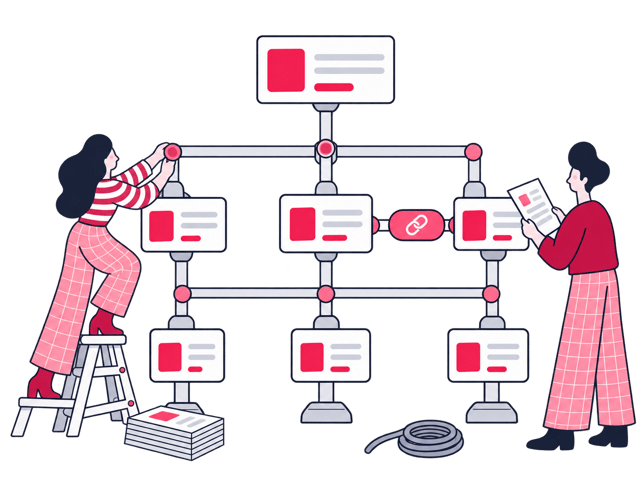
Cross-functional governance councils oversee domain taxonomy updates, preventing department teams from deploying competing subfolders.

On-Page SEO
Content & Keyword Optimization
Governance workflows define content review gates, ensuring marketing writers adhere to target keyword briefs and metadata standards.


Next step
Identify the decision that keeps holding up SEO work

Before we start