


Zeo delivery method
Site Architecture & Internal Linking
A target hierarchy mapped onto real pages, a link graph where every orphan is explained, and a pilot that proved the pattern before it went sitewide.
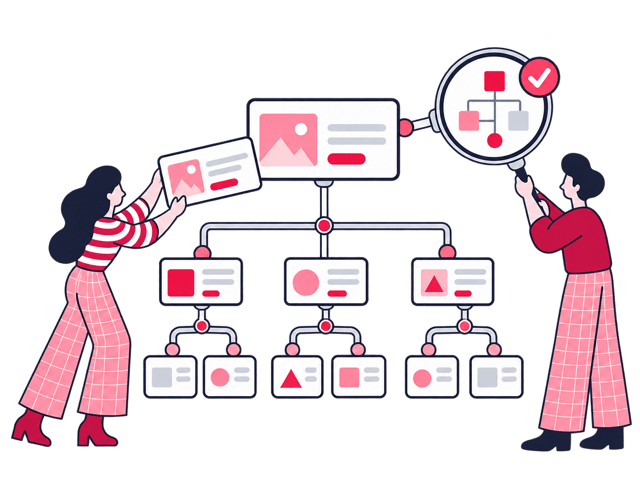
A page can be live and still sit three clicks from anywhere real, reachable only through a link nobody meant to leave there, which is rarely what the sitemap claims the structure looks like. We map the link graph that actually exists rather than the one that's supposed to, decide which pages should genuinely be easy to reach, and pilot the fix on real templates before it goes sitewide. We rebuild the hierarchy and the links inside it so priority pages are easy to reach, properly contextualized, and not hanging on a link someone forgot to remove.

Some of the 500+ brands we've worked with
Selected brands we’ve worked with across industries.
























 MeteksanGlobalCase Study





 VisperaGlobalCase Study














On this page
Stages and gates
How we do it
We name what should be easy to reach, then map what the site actually does today. The gap between the two becomes the pilot, and a sitewide rollout only happens once that pilot holds up.
Define what should be easy to reach
We name the pages that matter, the journeys that shouldn't break, and the role each page is meant to play, before touching a single link. A specialist confirms the final priority list and names an owner for every page before a single link gets touched.
A target architecture with an owner for every priority page.

Map the graph that exists
We crawl the rendered site, navigation, breadcrumbs, body links, all of it, and build one graph showing exactly how pages connect today. Each orphan and excess-depth flag gets read individually. Some of those pages are meant to stay buried, and our technical lead says which.
A clear list of orphaned pages, excess depth, and hub pages competing with each other.

Pilot the fix on genuine templates
We roll out the new hierarchy and contextual links on representative templates and check rendering, tracking, and accessibility before touching the whole site. A specialist reads the pilot evidence and decides whether the new hierarchy earns a sitewide rollout.
Evidence that the new structure holds up on genuine templates, before it ships everywhere.

Measure reach and journey safety
We recrawl, check whether priority pages got shallower and orphans got resolved, and confirm the journeys we promised to protect still work. The protected journeys are confirmed intact before anyone calls the pattern ready to scale, adjust, or stop.
A clear call to scale the pattern, adjust it, or stop, backed by the same graph we started with.



AI measures the graph before and after; people decide what should be easy to reach.
AI cross-references traffic, conversion, and content-type data to shortlist candidate priority pages, crawls the fully rendered site and computes click depth and incoming-link counts for every URL, runs the rendering, tracking, and accessibility checks against the piloted templates, and recrawls to diff click depth and orphan status against the same graph measured before the pilot. Priorities and rollout stay human. We do not add sitewide links or keyword-stuffed anchors to push authority toward one page, we will not strip navigation or bury a useful page without testing what that does to genuine journeys, and we will not promise a specific click-depth number for every page.
Deliverables and acceptance
What you get
Four things that make the site's shape provable.
Architecture map
Target architecture map
Link ledger
Internal link graph

Playbook
Anchor & linking playbook
Audit report
Reachability validation


We call it done when: The architecture map, link graph, linking playbook, and reachability validation are done when every priority page has a defined role, a named owner, and a stated reason for its position, every graph edge is a real rendered link with a source, destination, and anchor, the playbook states the anchor text, placement, and template rules that keep the next new page from undoing the fix, and the validation confirms click depth dropped and orphans resolved on the same cohort measured before the pilot.
Fit and readiness
When you need this
Link volume isn't the goal. A page three clicks deep with one confusing link pointing at it is still hard to find.
A good fit when
- Nobody currently owns your site hierarchy, so pages get added wherever's easiest instead of where they belong.
- You suspect some of your best pages are orphaned or buried, but you don't have a crawl that proves it either way.
- Click-depth and link-graph evidence is missing from architecture decisions, so nobody can tell which pages are genuinely buried.

Better handled as other work when
- You want a navigation redesign driven purely by visual preference, with no evidence about journeys or priority pages.
- You want a link-volume target that ignores what each individual link promises the reader.
If one of these is closer to your situation, start here instead: Technical SEO
We call it done when: You have a target architecture mapped onto genuine pages, a link graph where no orphan is left unexplained, and a pilot that proved the pattern before it went sitewide.
The specialists behind this SEO work
Zeo's SEO work goes back to 2006, when we started what we call the first SEO blog in the MENA region. The consultants shown here are doing that work today, matched to what this page covers.

Yiğit Konur
Founder & Chief Strategy Officer

Hande Parmaksız
SEO Manager

Metehan Urhan
New Business & Partnership Manager

Bensu Tınastepe
Senior SEO Analyst

Sinem Bakır Yavaş
Senior SEO Executive

Elif Naz Akan Karakoç
Senior SEO Executive

Sena Önder
Senior SEO Executive

Gülşah Şahin Özkan
Senior SEO Analyst

Ali Özgün Öz
SEO Executive

Ruhan Tiryaki
Senior SEO Analyst

Aybüke Göktuna
Senior SEO Analyst

Yağmur Bayram
Sr. SEO Analyst

Emir Kağan Kahveci
SEO Analyst

Mehmet Aktuğ
Co-Founder & COO

Zafer Yıldız
Web Analytics Manager
Tools we use
Tools behind this work
 Ahrefs
underlinked priority pages and context-ready internal link opportunities
 Screaming Frog
rendered link graph with depth, anchors, and orphan checks
 Sitebulb
crawl maps that reveal buried clusters and competing hubs
 Oncrawl
internal authority flow compared with priority page roles
 Google Search Console
sampled internal links and discovery evidence for priority pages
 Google Analytics
journey evidence for navigation and contextual link changes
Where this fits
Related services

Technical SEO
Crawl & Index Optimization
Logical hierarchical taxonomy and flat directory structures ensure search crawlers access deep category and product URLs within minimal hops.

Technical SEO
Core Web Vitals & Speed
Clean navigation component architectures eliminate heavy script payloads, reducing main-thread blocking time and improving page load speeds.
Technical SEO
Structured Data & Rendering
Hierarchical breadcrumb link structures match on-page BreadcrumbList schema, providing consistent site navigation signals to search engines.


Next step
Map how your site connects

Before we start